
SUBFAMILY DOLICHODERINAE
Genus Technomyrmex Mayr
|
|
The Ants of
Africa SUBFAMILY DOLICHODERINAE Genus Technomyrmex Mayr |
| Technomyrmex Introduction |
Key to workers of African species
Derived in part from that compiled by Wheeler (1922) for Engramma;
with additions and amendments following Bolton (2007).
| - | BT KEY | SPECIES | Bolton 2007 status |
| 1 | 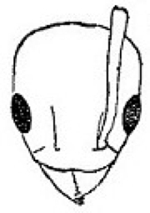 Head
shape approximately rectangular or ovoid, where impressed posteriorly
or anteriorly (the clypeal margin) the impression is no more than
shallow Head
shape approximately rectangular or ovoid, where impressed posteriorly
or anteriorly (the clypeal margin) the impression is no more than
shallow |
(subgenus Technomyrmex) 13 | . |
| -- | 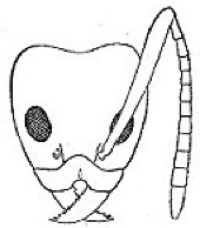 Head
shape cordiform, clypeus with distinct median notch Head
shape cordiform, clypeus with distinct median notch |
(subgenus Engramma) 2 | |
| - | (subgenus Engramma) | - | . |
| 2 | Notch on the clypeal margin more or less semi-circular with rounded lateral corners | 3 | . |
| -- | Head shape cordiform, clypeus with distinct medial notch which has sharp corners | 5 | |
| - | . | - | . |
| 3 | 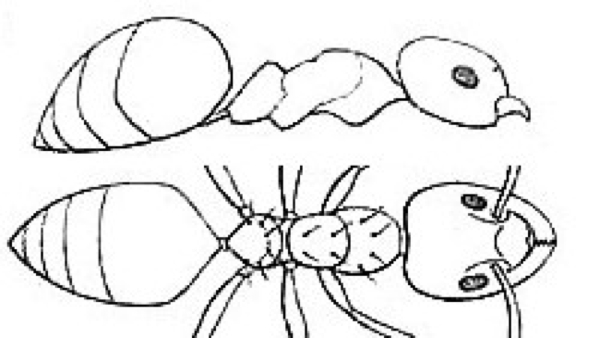 TL
3-3.2 mm CI 86-90 SI 91-100; pilosity of dark erect bristly hairs;
brownish yellow; median
notch of clypeus semi-circular or nearly so; separated by transverse
fine rugulose sculpture on the propodeal declivity TL
3-3.2 mm CI 86-90 SI 91-100; pilosity of dark erect bristly hairs;
brownish yellow; median
notch of clypeus semi-circular or nearly so; separated by transverse
fine rugulose sculpture on the propodeal declivity |
. | in arnoldinus group |
| . | 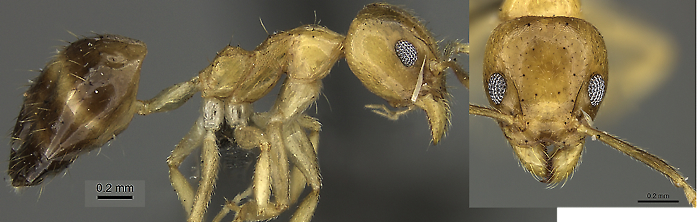 |
eastern &
southern Africa - arnoldinus |
in arnoldinus group |
| -- | Pilosity much reduced or absent |
4 | . |
| 4 | Promesonotum
profile
flattened with a slight impression at pronotum-mesonotum suture;
clypeus with well-defined impression of anterior margin |
4A | . |
| -- |
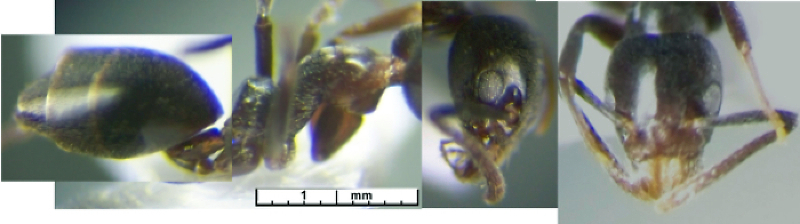 Promesonotum evenly convex in profile; anterior clypeal
margin very widely and
shallowly arcuately impressed; TL ca 3.3 mm CI 91 SI 89; head cordiform
but with a
near straight occiput; eyes set less than 2x own length from
occiput; no visible ocelli; propodeal dorsum long with a sharp angle to
the flat declivity;
no setae at all on gaster segments; whole body with a quite dense
covering of minute pubescence but with very little sculpturation so
shiny; almost completely dark brown, including coxae, gaster segments
with narrow pale border. Promesonotum evenly convex in profile; anterior clypeal
margin very widely and
shallowly arcuately impressed; TL ca 3.3 mm CI 91 SI 89; head cordiform
but with a
near straight occiput; eyes set less than 2x own length from
occiput; no visible ocelli; propodeal dorsum long with a sharp angle to
the flat declivity;
no setae at all on gaster segments; whole body with a quite dense
covering of minute pubescence but with very little sculpturation so
shiny; almost completely dark brown, including coxae, gaster segments
with narrow pale border. |
Central
African Republic - dzangae n. sp. |
new species here |
| 4A | 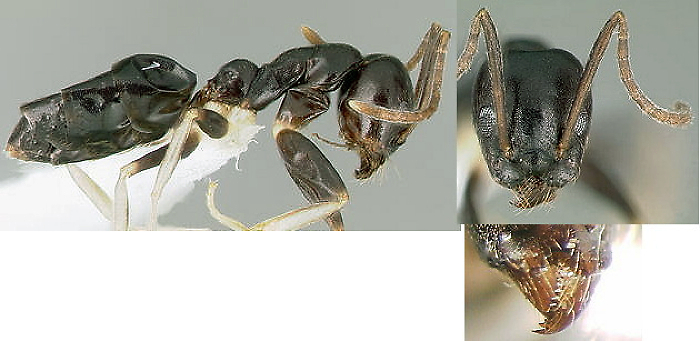 TL
2-7-4.3 mm CI 82-95 SI 102-130; dorsal surfaces alitrunk finely and
densely
reticulo-punctate; overall colour dark-brown to black; mid- and
hind-legs with coxae, trochanters and basal quarter to third of femora
white to yellow TL
2-7-4.3 mm CI 82-95 SI 102-130; dorsal surfaces alitrunk finely and
densely
reticulo-punctate; overall colour dark-brown to black; mid- and
hind-legs with coxae, trochanters and basal quarter to third of femora
white to yellow |
West Africa
& Congo Basin east to Kenya - andrei |
in bicolor group |
| -- | 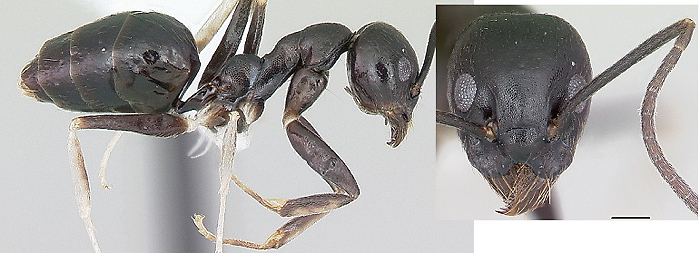 TL
3.5-3.7 mm CI 87 SI 118; apparently
separable from andrei solely by having yellow parts where they
are white in andrei; middle and hind coxae black, the hind
femur wholly black; the
variability of "andrei" suggests this is no more than weakly
justified TL
3.5-3.7 mm CI 87 SI 118; apparently
separable from andrei solely by having yellow parts where they
are white in andrei; middle and hind coxae black, the hind
femur wholly black; the
variability of "andrei" suggests this is no more than weakly
justified |
Gabon - parandrei |
Bolton n.sp. in bicolor group |
| -- | 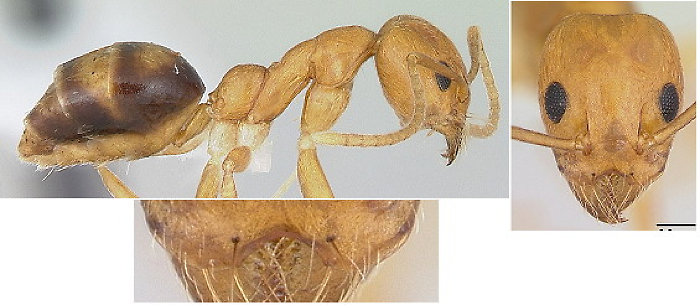 TL 3.1-3.5
mm CI 88 SI 125; apparently
separable from andrei solely on the basis of its pale colour TL 3.1-3.5
mm CI 88 SI 125; apparently
separable from andrei solely on the basis of its pale colour |
Central
African Republic - metandrei |
Bolton n.sp. in bicolor group |
| - | Head shape cordiform, clypeus with distinct medial notch which has sharp corners | - | . |
| 5 | Long slender species with elongated head and alitrunk | 6 | . |
| -- | Relatively short and without obvious elongation of head or alitrunk | 8 | |
| 6 | 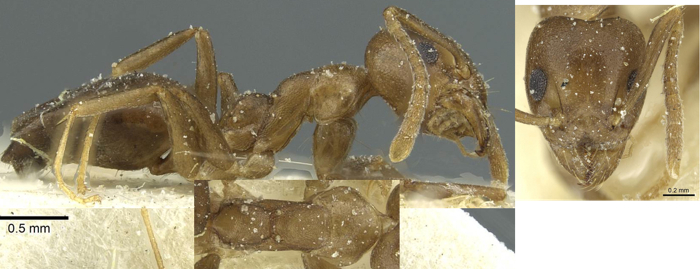 Frontal carinae with a single seta; TL 3.2-3.3 mm CI
91-94 SI 96-100;
uniformly medium to
dark brown Frontal carinae with a single seta; TL 3.2-3.3 mm CI
91-94 SI 96-100;
uniformly medium to
dark brown |
Mozambique - taylori |
as "taylori" in camerunensis group |
| -- | Frontal carinae with 2-3 setae, the posteriormost close to the level of the rear of the eye | 7 | |
| 7 | 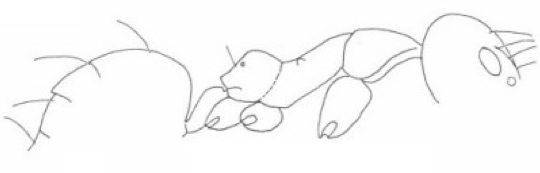 More or less uniformly
dark brown to black; TL 3.0-4.2 mm
CI 83-92 SI 125-148 More or less uniformly
dark brown to black; TL 3.0-4.2 mm
CI 83-92 SI 125-148 |
. | . |
| . | 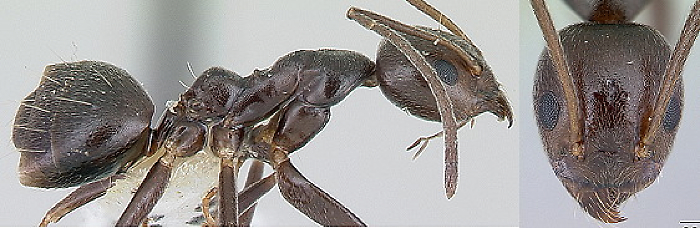 |
Cameroun and
Congo Basin east to Kenya - camerunensis |
new status in camerunensis group |
| -- | 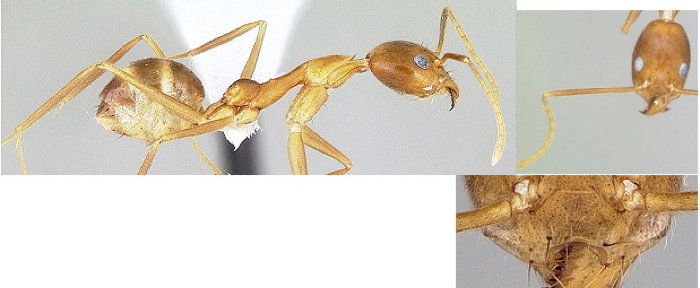 Larger,
TL 4.5-5.1 CI 70-74 SI 173-189, and more elongated; eyes set further
forward; lighter in
colour Larger,
TL 4.5-5.1 CI 70-74 SI 173-189, and more elongated; eyes set further
forward; lighter in
colour |
Gabon - schoedli |
new species in camerunensis group |
| - | . | - | . |
| 8 | Scapes surpassing the occiput | 9 | . |
| -- | Scapes not surpassing the occiput | 10 | . |
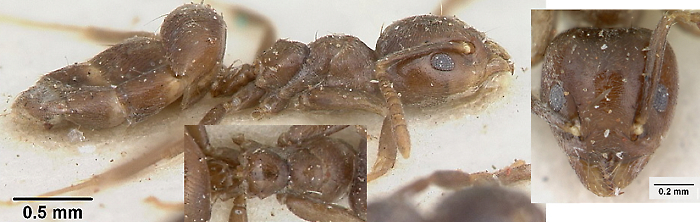
| 9 | 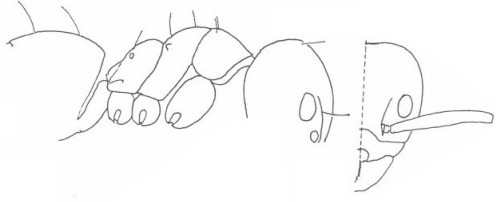 Scapes
surpassing the occiput by about one-fourth of their length; TL ca 3 mm
CI 96-100 SI 82-87;
colour dark, pubescence abundant; fine brownish hairs on alitrunk and
gaster; clypeus with wider median notch than voeltzkowi Scapes
surpassing the occiput by about one-fourth of their length; TL ca 3 mm
CI 96-100 SI 82-87;
colour dark, pubescence abundant; fine brownish hairs on alitrunk and
gaster; clypeus with wider median notch than voeltzkowi |
. | . |
| . |  |
East Africa -
ilgi |
in ilgi group |
| -- | 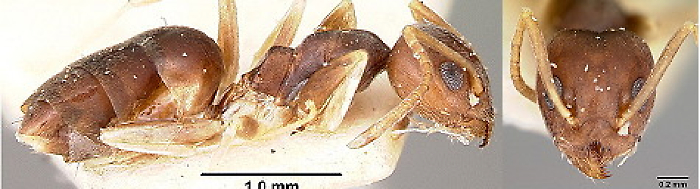 Scapes
surpassing the occiput by one-third to two-fifth of their length; TL
2.5-3.0 mm (Bolton 2-7-3.7 mm CI 83-95 SI 92-116); clypeal notch narrow
and deep; dorsum
of head behind the clypeus entirely without erect setae; short
inconspicuous pale pubescence all over; black, clypeus, femora and
scapes brown, rest of appendages yellowish Scapes
surpassing the occiput by one-third to two-fifth of their length; TL
2.5-3.0 mm (Bolton 2-7-3.7 mm CI 83-95 SI 92-116); clypeal notch narrow
and deep; dorsum
of head behind the clypeus entirely without erect setae; short
inconspicuous pale pubescence all over; black, clypeus, femora and
scapes brown, rest of appendages yellowish |
Eastern & southern Africa -
voeltzkowi |
in textor group [dubious grouping as all others have the clypeal margin shallowly impressed] |
| - | . | - | . |
| 10 | Head roughly triangular with curved sides; propodeum profile no more than weakly convex | 11 | new species in lasiops group |
| -- | Head, without the mandibles, as broad as long, deeply excavated behind; propodeum profile with a distinct rise from the metanotal groove and a domed transition to the decilivity | 12 | . |
| 11 | 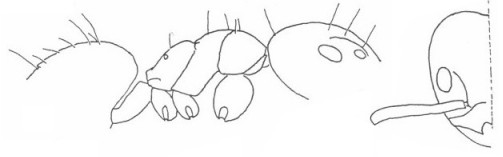 Dorsum
of head behind the clypeus with 4 pairs of erect setae; TL 2.3-2.7 mm
CI 87-91 SI 83-88;
overall yellowish brown, gaster slightly darker Dorsum
of head behind the clypeus with 4 pairs of erect setae; TL 2.3-2.7 mm
CI 87-91 SI 83-88;
overall yellowish brown, gaster slightly darker |
. | . |
| . | 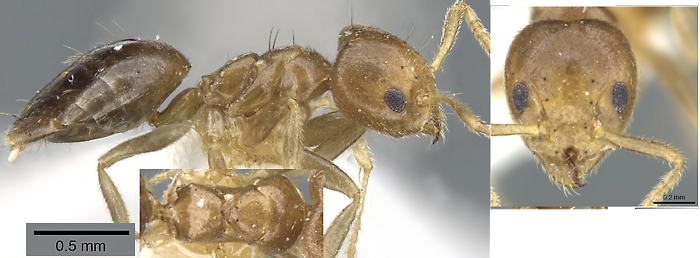 . . |
Cameroun,
Gabon, Congo - lasiops |
new species in lasiops group |
| -- | 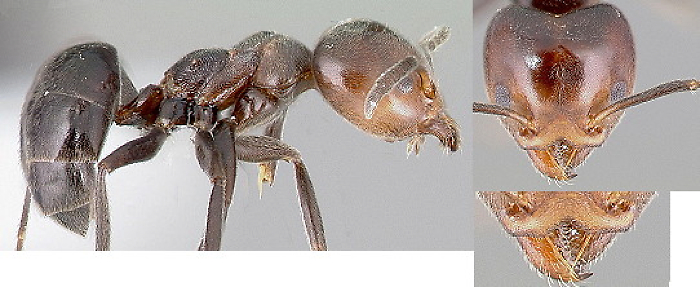 Without
erect hairs on the head or body; TL 2.8-3.3 mm CI 100-110 SI 67-76;
antennal scapes
slightly surpassing the occipital border; funicular joints 2 to 7
slightly longer than broad; base of propodeum nearly as long as the
declivity, horizontal; pilosity well developed; colour
anteriorly red-yellow, posteriorly dark brown; Without
erect hairs on the head or body; TL 2.8-3.3 mm CI 100-110 SI 67-76;
antennal scapes
slightly surpassing the occipital border; funicular joints 2 to 7
slightly longer than broad; base of propodeum nearly as long as the
declivity, horizontal; pilosity well developed; colour
anteriorly red-yellow, posteriorly dark brown; |
Zaïre, Cameroun & Gabon - lujae |
in lujae group |
| 12 | 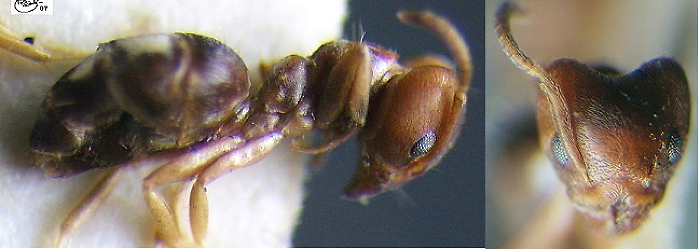 Antennal
scapes not reaching the occipital border; funicular joints 2 to 7
broader than long; base of propodeum much shorter than the declivity,
sloping forward; TL 2.25 to 3 mm CI 100 SI 67; head strongly
cordiform, deeply
scalloped posteriorly; eyes large, flat, anterior of mid-point of head;
erect hairs fairly numerous on all surfaces; brown, gaster blackish (congolensis
much lighter) Antennal
scapes not reaching the occipital border; funicular joints 2 to 7
broader than long; base of propodeum much shorter than the declivity,
sloping forward; TL 2.25 to 3 mm CI 100 SI 67; head strongly
cordiform, deeply
scalloped posteriorly; eyes large, flat, anterior of mid-point of head;
erect hairs fairly numerous on all surfaces; brown, gaster blackish (congolensis
much lighter) |
Congo Basin -
laurenti |
in laurenti group |
| -- | 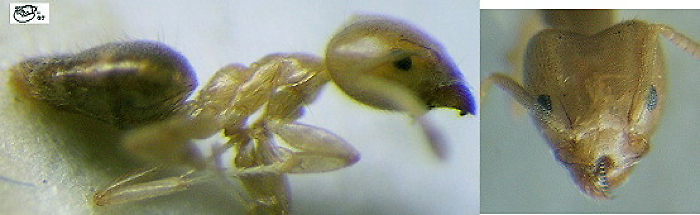 TL
1.8 to 2.2 mm CI 97 SI 74; dull yellow, with brown gaster; smaller,
alitrunk with
no more than two pairs of erect setae on the pronotum (abraded but
insertions clearly marked); over with much less obvious and finer
pubescence and generally much shinier; gaster in contrast with more
abundant but finer and longer erect setae; brownish-yellow with a
darker but still yellowish gaster TL
1.8 to 2.2 mm CI 97 SI 74; dull yellow, with brown gaster; smaller,
alitrunk with
no more than two pairs of erect setae on the pronotum (abraded but
insertions clearly marked); over with much less obvious and finer
pubescence and generally much shinier; gaster in contrast with more
abundant but finer and longer erect setae; brownish-yellow with a
darker but still yellowish gaster |
Congo Basin - kohli |
j.syn. of laurenti in laurenti group |
 |
subgenus Technomyrmex | . | albipes
group . |
| 13 | Dorsum of head behind the clypeus entirely without erect hairs (setae); clypeal margin with a shallow median impression less than semicircular | 14 | textor group; parviflavus complex |
| -- | Dorsum of head behind the clypeus with erect hairs present | 16 | |
| 14 | 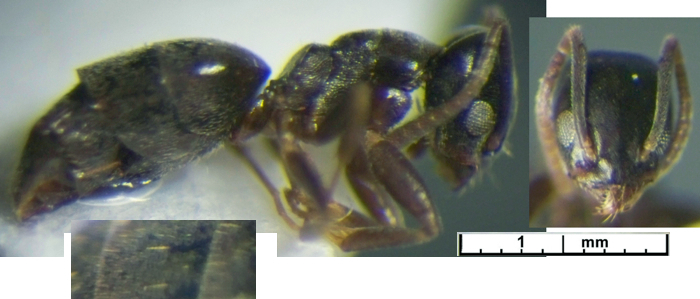 Decumbent but
distinct hairs on all gastral tergites; TL 3.2 mm CI 89 SI 100 Decumbent but
distinct hairs on all gastral tergites; TL 3.2 mm CI 89 SI 100 |
Cameroun - nsp Cameroun fk um20 |
new species |
| -- | At least gastral tergites 1 without
hairs |
14A | . |
| 14A | 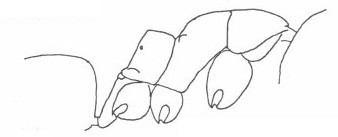 TL 2.5-2.8 mm
CI 82-88 SI 122-129;
third gastral tergite with suberect hairs; uniformly dark brown, except
for
yellow trochanters and the middle and hind coxae (apparently not always
lighter) TL 2.5-2.8 mm
CI 82-88 SI 122-129;
third gastral tergite with suberect hairs; uniformly dark brown, except
for
yellow trochanters and the middle and hind coxae (apparently not always
lighter) |
. | . |
| . | 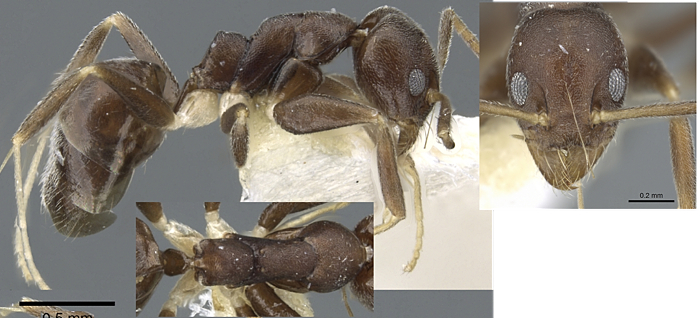 |
West Africa
& Congo Basin - senex |
new species - textor group; parviflavus complex |
| -- | With gaster distinctly darker than the head and alitrunk; gastral tergites 1-3 without setae | 15 | . |
| 15 | 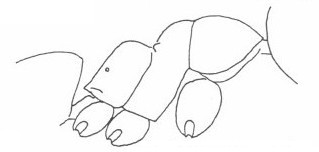 TL
1.9-2.9 mm CI 81-89 SI 110-126; overall dull yellow, head and gaster
slightly darker;
propodeal dorsum shorter than length of declivity to the spiracle TL
1.9-2.9 mm CI 81-89 SI 110-126; overall dull yellow, head and gaster
slightly darker;
propodeal dorsum shorter than length of declivity to the spiracle |
. | . |
| . | 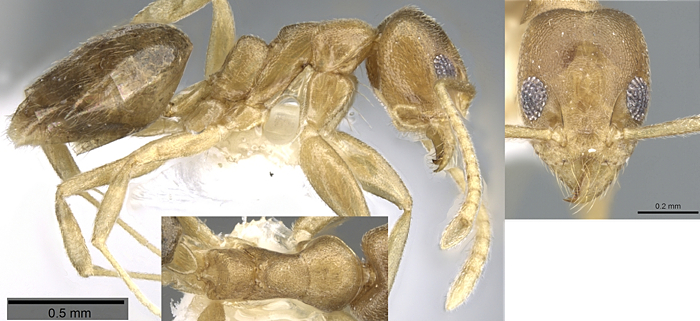 |
West Africa
& Congo Basin - parviflavus |
new species - textor group; parviflavus complex |
| -- | 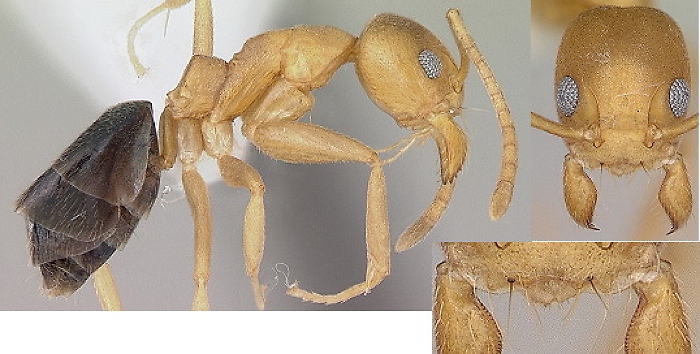 TL 2.7-3.0
mm CI 81-83 SI 134-135; scapes longer and eyes slightly smaller than parviflavus,
the propodeal profile shows the length of the dorsum to be greater than
the length of the declivity to the spiracle TL 2.7-3.0
mm CI 81-83 SI 134-135; scapes longer and eyes slightly smaller than parviflavus,
the propodeal profile shows the length of the dorsum to be greater than
the length of the declivity to the spiracle |
Gabon - sycorax |
new species - textor group; parviflavus complex. |
| - | . | . | . |
| 16 | 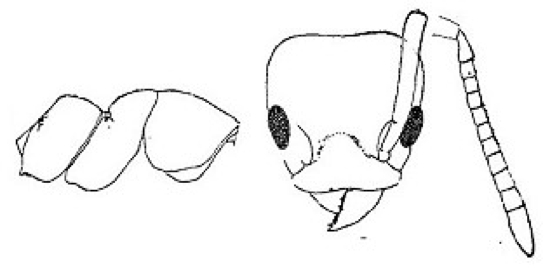 Gastral
tergites 2-3 without setae; TL 3.4-3.6 mm CI 99 SI 85; head width and
length
approximately the same; with posterior wide and shallowly impressed;
metanotal groove deep; propodeum declivity flat and sub-bordered; quite
dense greyish pubescence not hiding fine dense puncturate
sculpturation; black, appendages dark brown; shiny, with dense
puncturation Gastral
tergites 2-3 without setae; TL 3.4-3.6 mm CI 99 SI 85; head width and
length
approximately the same; with posterior wide and shallowly impressed;
metanotal groove deep; propodeum declivity flat and sub-bordered; quite
dense greyish pubescence not hiding fine dense puncturate
sculpturation; black, appendages dark brown; shiny, with dense
puncturation |
. | . |
| . | 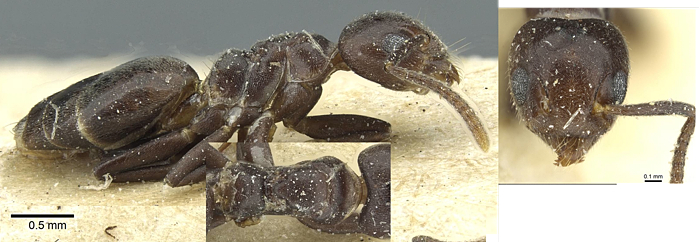 |
Zaïre - rusticus |
in albipes group but in no named complex. |
| -- | Gastral tergites 2-3 with setae, ranging from 1-2 pairs to many | 17 | . |
| 17 | Dorsal or outer surfaces of middle and hind tibiae with numerous suberect to erect setae | 18 | . |
| -- | Dorsal or outer surfaces of middle and hind tibiae without any setae | 19 | . |
| 18 | 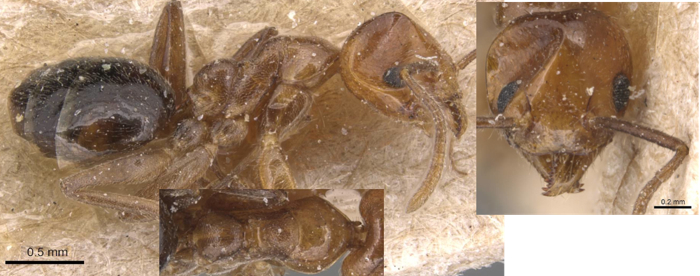 TL
2.75-3.25 mm CI 99 SI 97; shiny but muted by quite dense pubescence;
erect hairs on
all parts; rust-red with gaster black; TL
2.75-3.25 mm CI 99 SI 97; shiny but muted by quite dense pubescence;
erect hairs on
all parts; rust-red with gaster black; |
West Africa - semiruber | in albipes group |
| -- | 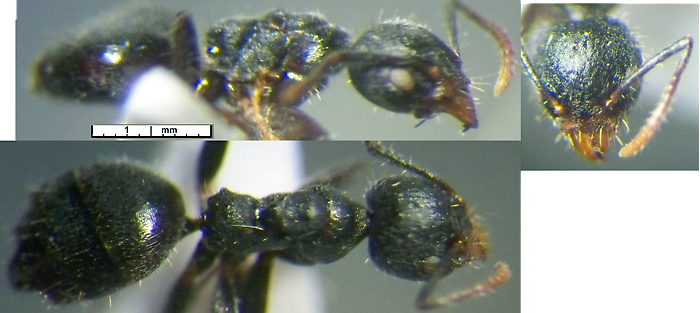 Queen only known; TL 5.4 mm CI 96
SI 92,
generally like schoutedeni but with prominent fine setae all
over Queen only known; TL 5.4 mm CI 96
SI 92,
generally like schoutedeni but with prominent fine setae all
over |
Cameroun - pilipes | unchanged, in schoutedeni group |
| - | . | . | . |
| 19 | Dorsal surfaces of pro- and mesonotum without setae | 20 | . |
| -- | Dorsal surfaces of either pro- and mesonotum, or both, with at least one pair of erect setae | 21 | |
| 20 | No image but very close to schoutedeni - TL 3.4-3.5 mm; clypeal notch broad and shallow, the median border without an impression; funicular joints shorter; colour yellowish red, gaster black, its segments narrowly bordered with yellow | Tanzania & Zaïre - zimmeri | in schoutedeni group |
| -- | 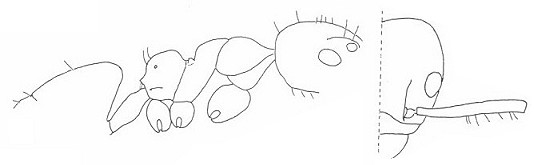 TL
3.6-4.3 mm CI 91-97 SI 92-108; scape surpasses occiput by about 1/6 its
own length;
alitrunk weakly convex with a marked suture; mesonotum dorsum slightly
long than wide, with raised spiracles; propodeum strongly domed but
more convex than in semiruber, spiracles well raised tubercular
with a strong hair; head and pronotum subopaque, partly matt, very
densely puncturate, rest of alitrunk matt and densely
reticulo-punctate; gaster shiny but finely reticulate; very few erect
hairs, 2-3 yellowish on alitrunk; pubescence yellowish, very fine,
quite distinct and abundant throughout; brown, mandibles dull red,
gaster dull yellow or slightly brown. TL
3.6-4.3 mm CI 91-97 SI 92-108; scape surpasses occiput by about 1/6 its
own length;
alitrunk weakly convex with a marked suture; mesonotum dorsum slightly
long than wide, with raised spiracles; propodeum strongly domed but
more convex than in semiruber, spiracles well raised tubercular
with a strong hair; head and pronotum subopaque, partly matt, very
densely puncturate, rest of alitrunk matt and densely
reticulo-punctate; gaster shiny but finely reticulate; very few erect
hairs, 2-3 yellowish on alitrunk; pubescence yellowish, very fine,
quite distinct and abundant throughout; brown, mandibles dull red,
gaster dull yellow or slightly brown.Type worker image poor due to a covering of glue. |
Zaïre - schoutedeni | in schoutedeni group |
| . | . | . | . |
| 21 | 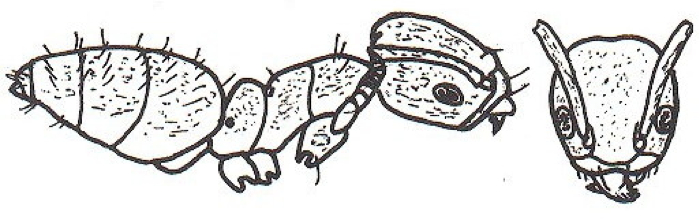 Head without erect
setae behind the level of the posterior
margin of the eye; gastral tergites 1-4 with numerous erect setae Head without erect
setae behind the level of the posterior
margin of the eye; gastral tergites 1-4 with numerous erect setae |
22 | . |
| -- | Head with one or more pairs of erect setae behind the level of the posterior margin of the eye | 25 | |
| 22 | 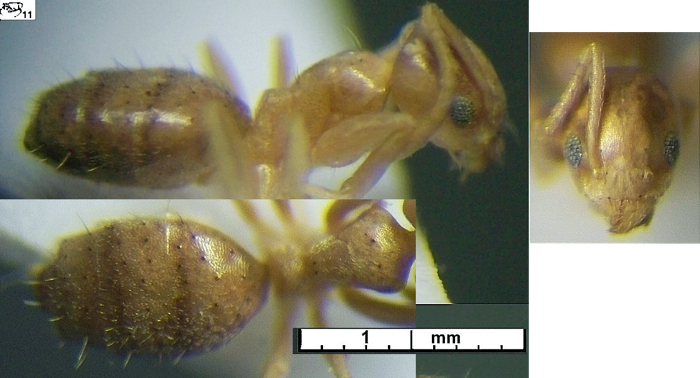 TL ca 2.4 mm, CI 89, OI 26; SI 100; uniform yellow-brown TL ca 2.4 mm, CI 89, OI 26; SI 100; uniform yellow-brown |
Congo - new species Mayombe | in albipes group |
| -- | Bicoloured or darker brown to black | 22A | . |
| 22A | 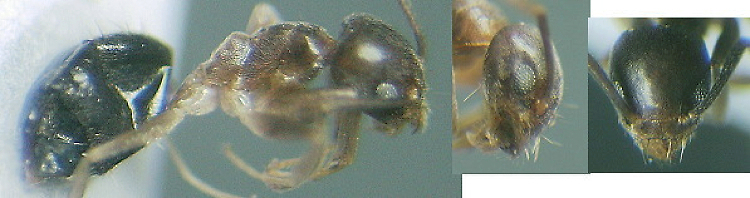 TL 2.2-2.7 mm CI 88-92
SI 100-108; bicoloured, head and
alitrunk yellow (posterior
head and alitrunk dorsum often darker, as example), gaster black TL 2.2-2.7 mm CI 88-92
SI 100-108; bicoloured, head and
alitrunk yellow (posterior
head and alitrunk dorsum often darker, as example), gaster black |
Panafrican - nigriventris | in albipes group |
| -- | Darker brown to black | 23 | |
| 23 | 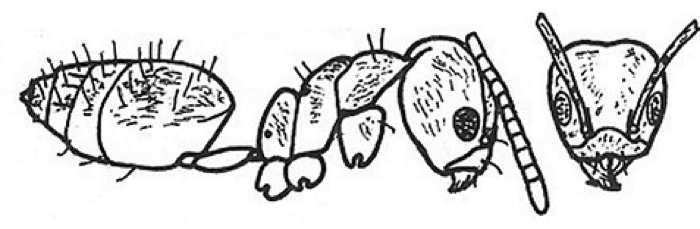 Lateral
margins of propodeal declivity without erect setae; TL 2.4-2.5 mm CI
87-92 SI 104-120; head
longer than wide, much narrower anteriorly; eyes longer than wide;
colour brown, erect hairs quite long Lateral
margins of propodeal declivity without erect setae; TL 2.4-2.5 mm CI
87-92 SI 104-120; head
longer than wide, much narrower anteriorly; eyes longer than wide;
colour brown, erect hairs quite long |
. | . |
| . | 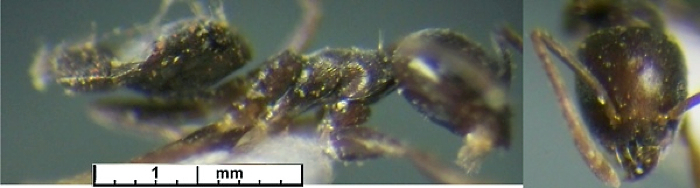 |
West Africa & Congo Basin - moerens | . |
| -- | Lateral margins of propodeal declivity with 1-3 pairs of erect setae | 24 | |
| 24 | 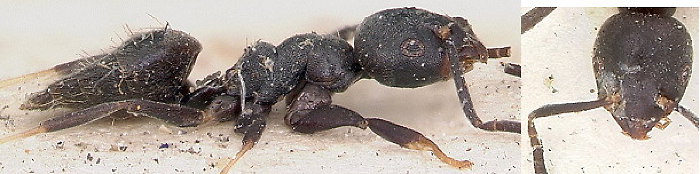 Dark
species, with pale tarsi, mandibles, scapes and funiculi; TL 2.4-2.9
mm CI 87-95 SI 91-102; scapes not surpassing the occiput; gastral
tergites 1-4 with
numerous erect setae; propodeum dorsum and declivity with a rounded
transition Dark
species, with pale tarsi, mandibles, scapes and funiculi; TL 2.4-2.9
mm CI 87-95 SI 91-102; scapes not surpassing the occiput; gastral
tergites 1-4 with
numerous erect setae; propodeum dorsum and declivity with a rounded
transition |
Tramp species - albipes | in albipes group |
| -- | 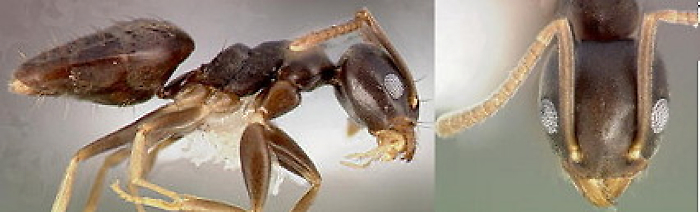 Propodeum
dorsum and declivity with a distinct angle at the transition;
larger eyes than albipes; TL 2.4-3.1 mm CI 85-93 SI 104-115 Propodeum
dorsum and declivity with a distinct angle at the transition;
larger eyes than albipes; TL 2.4-3.1 mm CI 85-93 SI 104-115 |
tramp species, not known from Africa - vitiensis | in albipes group |
| - | . | . | . |
| 25 | Larger species, HL > 0.80, HW > 0.75, SL > 0.70; propodeal profile with a long curved dorsum | 26 | . |
| -- | Smaller species | 27 | |
| 26 | 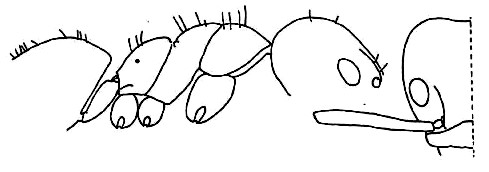 TL 3.5-3.6
mm CI 97 SI 97; gaster black, strongly contrasting with the head and
alitrunk; more
densely hairy TL 3.5-3.6
mm CI 97 SI 97; gaster black, strongly contrasting with the head and
alitrunk; more
densely hairy |
. | . |
| . | 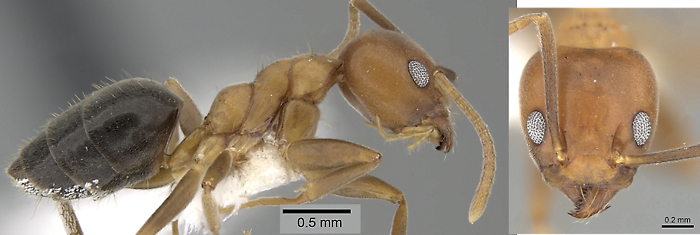 |
Tanzania - hostilis | in albipes group |
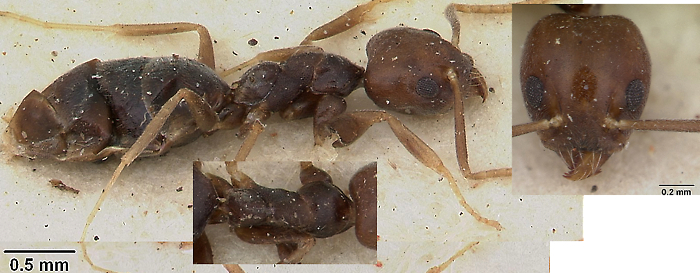
| -- | 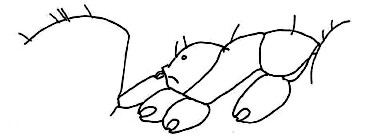 TL 3.4-3.5
mm CI 92-94 SI 99-100; generally uniform blackish-brown to black;
middle and hind tarsi
yellow lighter than tibiae and femora TL 3.4-3.5
mm CI 92-94 SI 99-100; generally uniform blackish-brown to black;
middle and hind tarsi
yellow lighter than tibiae and femora |
. | . |
| . |  |
Zimbabwe - menozzii | in albipes group |
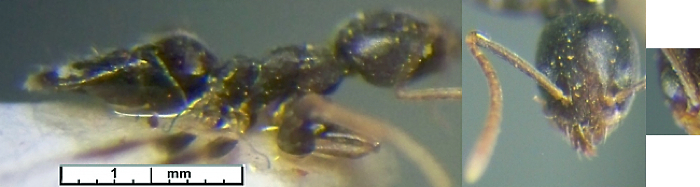
| 27 | 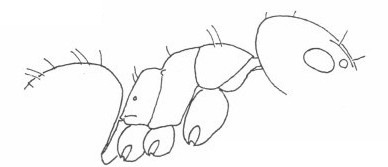 TL
2.2-2.5 mm 84-94 CI SI 92-106; variably coloured from generally uniform
light brown to
black; sometimes with the gaster darker; legs lighter than head and body TL
2.2-2.5 mm 84-94 CI SI 92-106; variably coloured from generally uniform
light brown to
black; sometimes with the gaster darker; legs lighter than head and body |
. . | . |
| . |  . . |
Pan-African & Tramp - pallipes | in albipes group |
| -- | 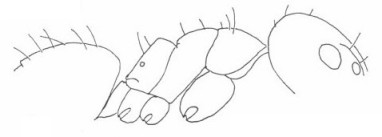 TL 2.6-3.2
mm CI 90-97 SI 94-104; eyes smaller; more brightly coloured with head
light orange-brown,
alitrunk and petiole dull yellow, gaster slightly darker TL 2.6-3.2
mm CI 90-97 SI 94-104; eyes smaller; more brightly coloured with head
light orange-brown,
alitrunk and petiole dull yellow, gaster slightly darker |
. | new species in albipes group |
| . | 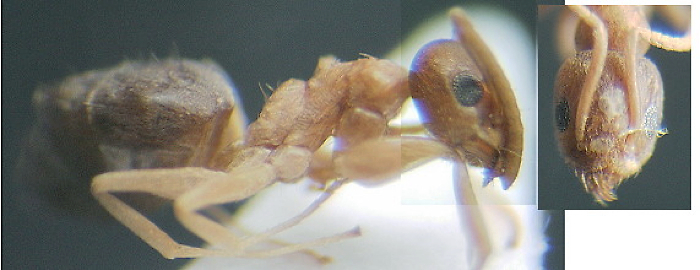 |
Kenya & Tanzania - vapidus | new species in albipes group |
Described as widespread, 821 workers from fourteen sites, in Ghana semi-deciduous forest leaf litter by Belshaw & Bolton (1994b).
Described as widespread, 168 workers from eleven sites, in Ghana semi-deciduous forest leaf litter by Belshaw & Bolton (1994b).
Three workers found in secondary forest leaf litter at CRIG, Ghana, by Belshaw & Bolton (1994b) = nigriventris.
In Ghana, three workers were found in primary forest (Mankrang Forest Reserve) and cocoa (Asiakwa) leaf litter by Belshaw & Bolton (1994b).
Described as widespread, 530 workers from ten sites, in Ghana semi-deciduous forest leaf litter by Belshaw & Bolton (1994b).
From Bolton (2007) the three common species in Belshaw's findings can be deduced as T. andrei, T. moerens and T. parviflavus. The fourth remains enigmatic but T. andrei was sighted from Mankrang and T. parviflavus was sighted from Asiakwa.
From Ghana at the Mampong Cemetery Farm on leaf litter and herbs under cocoa (Room, 1971); also on cocoa at Kade by Majer (1975). Also collected by Bigger (1981a) at CRIG, 6 workers by pkd from Amelonado cocoa canopy and 19 from the ground under the cocoa.
From Ghana at the Mampong Cemetery Farm on leaf litter and nesting in dead wood under cocoa (Room, 1971).
Collected in Ghana by Bigger (1981a) at CRIG, 7 workers from the ground under Amelonado cocoa.
From Ghana at the Mampong Cemetery Farm on herbs under cocoa (Room, 1971).
From Ghana at the Mampong Cemetery Farm on leaf litter and nesting in dead wood under cocoa (Room, 1971).
Found on Ghana cocoa at Kade by Majer (1975, 1976b), using pkd, with 14-20 workers per sample.
From Ghana on cocoa mistletoe (Room, 1975).
 |
© 2007. 2008, 2009, 2010, 2011, 2013, 2014 - Brian
Taylor
CBiol FSB FRES 11, Grazingfield, Wilford, Nottingham, NG11 7FN, U.K. |
href="technomyrmex_2011_key.htm"