
Genus Camponotus subgenus Tanaemyrmex
|
|
The Ants of
Africa Genus Camponotus subgenus Tanaemyrmex |
| Genus Camponotus |
Subgenus Tanaemyrmex Ashmead (1905b: 384) - member species regarded as in Myrmoturba by Wheeler (1922); synonymized by Emery (1925b: 75).
Ashmead wrote only "Tribe III. - Camponotini.
Genera: ... Tanaemyrmex,
Ashm.
n. g. (type Formica longipes,
Gerst.)" [see Camponotus (Tanaemyrmex) etiolipes
(Gerstäcker)] also "Dinomyrmex,
Ashm., n. g. (type Formica gigas,
Latr.) [Latreille, 1802c: 105, also F Smith, 1858b: 14, from India,
Bingham, 1903: 369; see www.antweb.org
images]. Myrmoturba Forel (1912i) and Dinomyrmex
Ashmead (1905b). Forel (192i) is at 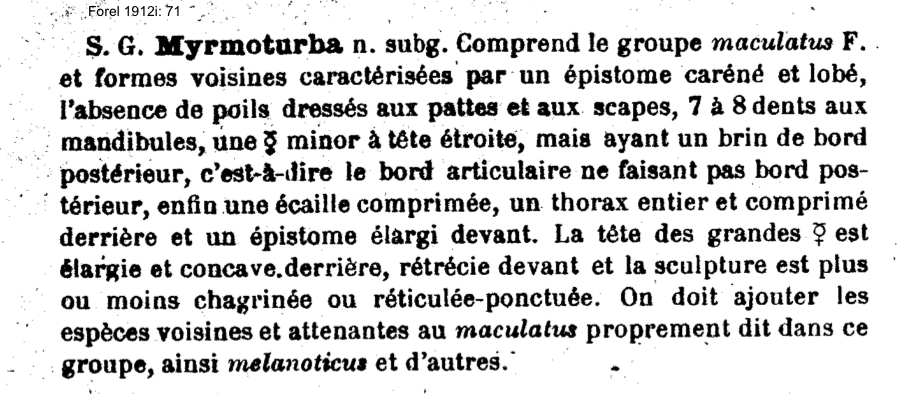
 Subgenus definition --
clypeus carinate, with pronounced
anterior median lobe (usually rectangular). Head of major usually much
wider posteriorly, occiput usually without a border; minor head with
parallel sides, sometimes narrowed posteriorly; mandibles usually with
6-7 teeth; thorax dorsum arcuate, rarely with propodeum slightly
depressed and saddle-shaped. Usually nesting in ground or under stones
(truly global with very many species).
Subgenus definition --
clypeus carinate, with pronounced
anterior median lobe (usually rectangular). Head of major usually much
wider posteriorly, occiput usually without a border; minor head with
parallel sides, sometimes narrowed posteriorly; mandibles usually with
6-7 teeth; thorax dorsum arcuate, rarely with propodeum slightly
depressed and saddle-shaped. Usually nesting in ground or under stones
(truly global with very many species).
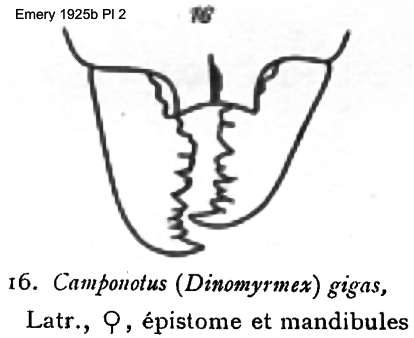 Emery
(1925b: 63) separated subgenus Dinomyrmex
as having the mandibles with some reduced (géminée) teeth; clypeus
carinate, extended forward as a strong lobe, impressed medianly and
each side with a raised angle in the form of a tooth; giant Malay
species. Under Tanaemyrmex
(as follows) he had "Camponotus
subg. Dinomyrmex (part) [all
except gigas,
the species in Forel, 1912: 91, and Forel, 1914a: 259, 268]. This was
contrary to the separation in Wheeler (1922: 239 ff) where pompeius, langi, caesar, massinissa and wellmani were in Dinomyrmex; plus (962 ff) aequatorialis, brevicollis, caffer, immigrans, longipes, sexpunctatus, and varus (with their then subspecies,
etc.).
Emery
(1925b: 63) separated subgenus Dinomyrmex
as having the mandibles with some reduced (géminée) teeth; clypeus
carinate, extended forward as a strong lobe, impressed medianly and
each side with a raised angle in the form of a tooth; giant Malay
species. Under Tanaemyrmex
(as follows) he had "Camponotus
subg. Dinomyrmex (part) [all
except gigas,
the species in Forel, 1912: 91, and Forel, 1914a: 259, 268]. This was
contrary to the separation in Wheeler (1922: 239 ff) where pompeius, langi, caesar, massinissa and wellmani were in Dinomyrmex; plus (962 ff) aequatorialis, brevicollis, caffer, immigrans, longipes, sexpunctatus, and varus (with their then subspecies,
etc.).
Emery (1925b: 76) recognised three groups of workers:-
alpha - with sides of head parallel and occipital border usually
rounded, vertex not impressed
beta - with sides convergent behind; vertex clearly depressed and the
eyes are well removed from the occipital border
gamma - even more accentuated than beta, the posterior of the head
being cone-shaped with the occipital border reduced to a narrow
articulation, sometimes extended into a neck, particuarly in forms
where the cone-shape is not so accentuated
Emery added that intermediates also could be found.
Emery listed the subgenus members the species as follow (African
members only) -
maculatus-gouldi-group - aequatorialis, brevicollis,
caffer, crawleyi, donisthorpei, guttatus,
hova ssps, immigrans, langi, longipes, maculatus
with many ssps, masimissa, pompeius, sexpunctatus,
varus and wellmani
irritans-thraso-group - acvapimensis, arnoldinus,
bianconii, baynei, cleobulus, kersteni, maguassa,
thales and thraso ssps
compressus-sylvaticus-group - compressus ssps probativa
& incommoda, congolensis, fornasinii, knysnae,
solon (with ssp brutus and varieties chiton, jugurtha
and lycurgus) and somalinus
ungrouped - rubripes, werthi
Santschi (1926a) gave a consideration of the then subgenera - Tanaemyrmex
Ashmead (1905b), Myrmoturba Forel (1912i) and Dinomyrmex
Ashmead (1905b). This is at 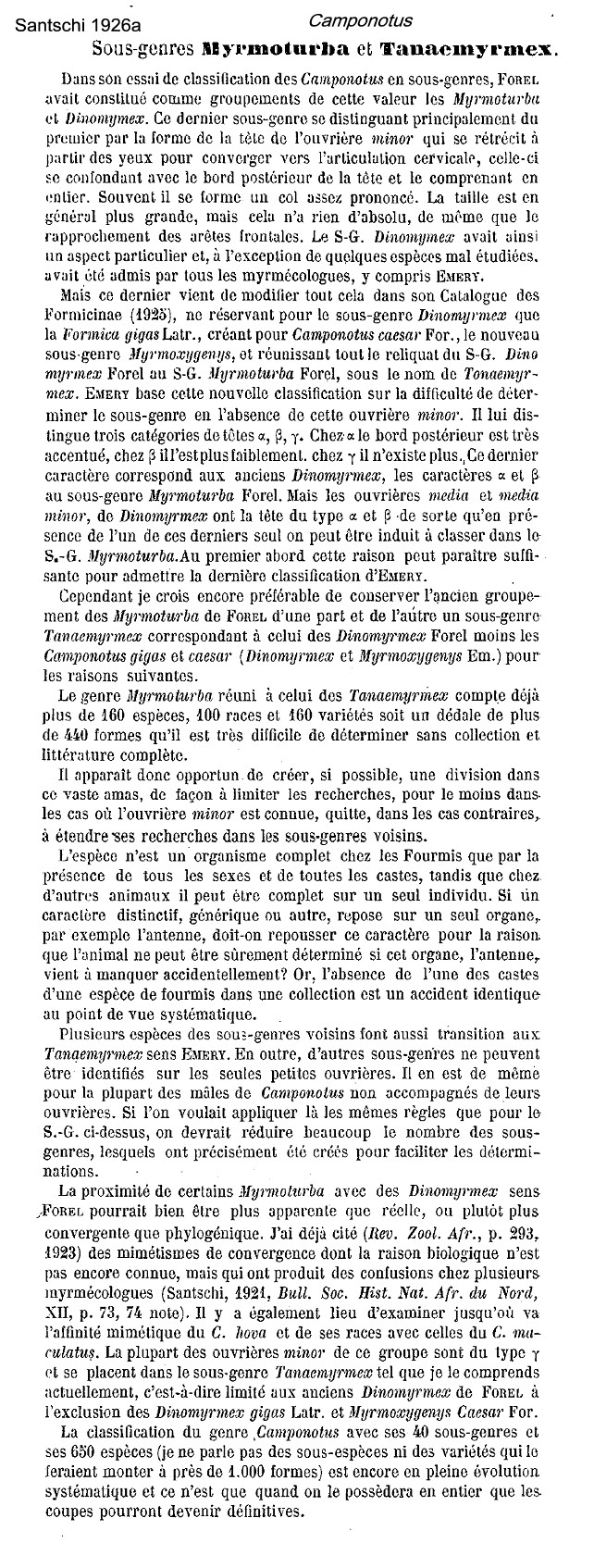 . The peculiarity of the minor forms where
the head is dramatically narrowed behind the occiput, apparently used
for separating subgenus Dinomyrmex, was left in confusion.
Apart from the strange apparently monomorphic Camponotus (Myrmoxygenys) caesar,
my observation is that such minors appear to be restricted to what I
have termed the pompeius-group. Even so, as will be seen under Camponotus
maculatus, the proliferation of subspecies and varieties leaves
chaos. Santschi also pointed out that he regarded Camponotus hova,
primarily from Madagascar but with some purported forms from South
Africa, as a mimetic of maculatus.
. The peculiarity of the minor forms where
the head is dramatically narrowed behind the occiput, apparently used
for separating subgenus Dinomyrmex, was left in confusion.
Apart from the strange apparently monomorphic Camponotus (Myrmoxygenys) caesar,
my observation is that such minors appear to be restricted to what I
have termed the pompeius-group. Even so, as will be seen under Camponotus
maculatus, the proliferation of subspecies and varieties leaves
chaos. Santschi also pointed out that he regarded Camponotus hova,
primarily from Madagascar but with some purported forms from South
Africa, as a mimetic of maculatus.
Note I have reconised a new species-complex, guttatus-complex, within the maculatus-group; majors with heads longer than wide, approximately rectangular in full face view with weakly arcuate sides and an only shallowly impressed occipitum. Members presently abjectus (Santschi, 1937d: 242); guttatus Emery (1899e: 498); kersteni (Gerstäcker, 1871: 355); minisculus (Viehmeyer, 1914c); and proletaria Baroni Urbani (1971b: 362, solely as a replacement name for Camponotus (Myrmoturba) maculatus F. st. miserabilis n.st. Santschi (1914d: 379, soldier & worker); itself according to Baroni Urbani, 1972: 123). Baroni Urbani's multiple synonymization (1972: 123 ff) of the many so-called varieties of maculatus was presented with very little detail of his actual study of specimens, although he noted he had seen the specimens in Basel and Parigi, as well as material in London.
Provisional key to Major morph of African species - based primarily on historical descriptions, caution is urged and the main descriptions should be perused to verify any diagnosis; illustrations of perceived minors also are given where possible.
Although, I am leaving it in this catalogue as a substantive
species, C. rubripes Latreille seems to be too enigmatic to be
a recognisable species. Forel (1886f) summarised the characters common
to all subspecies, varieties and races of rubripes and that is
on - 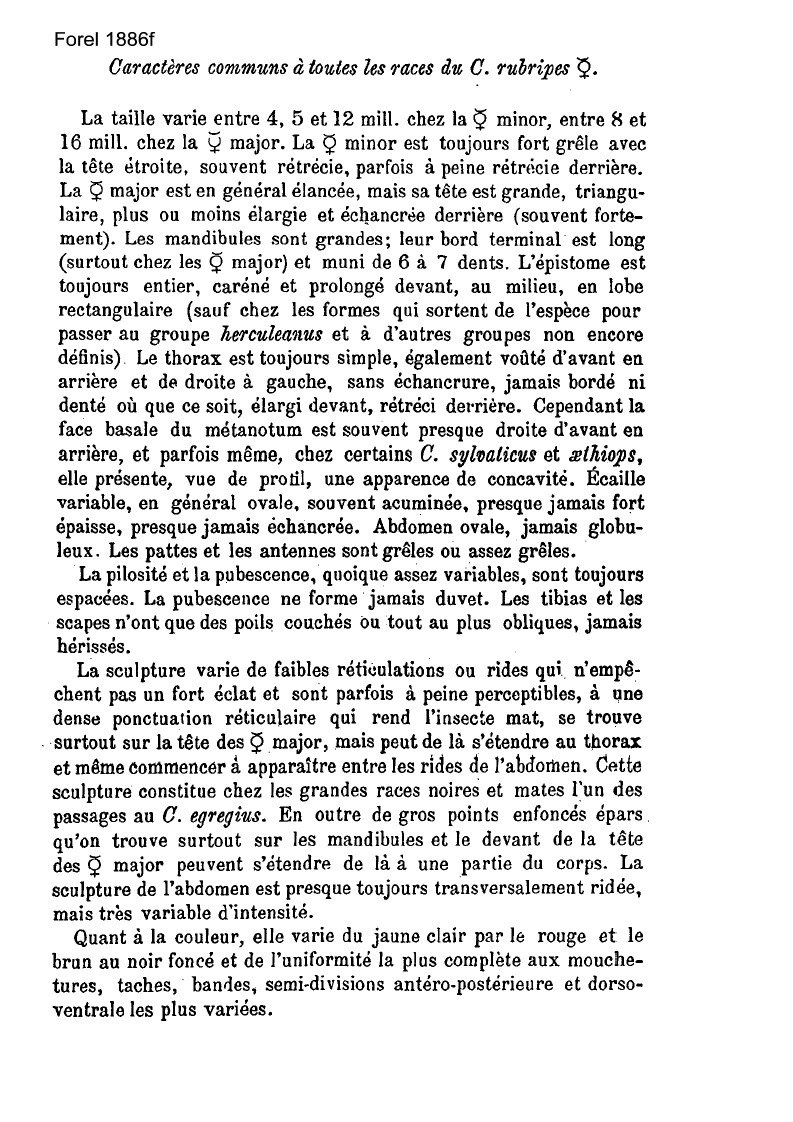 , giving more a set of
characters for the subgenus than anything else.
, giving more a set of
characters for the subgenus than anything else.
| A1 | 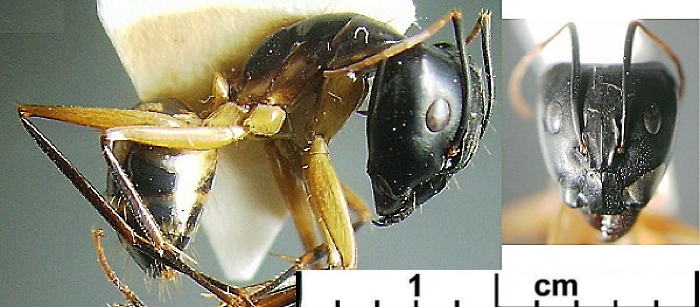 Majors with alitrunk profile
convex in a
smooth elongated curve, propodeal declivity (when obvious from angle
with dorsum) very short (at least two species-complexes), from above
with a narrow posterior at transition to declivity Majors with alitrunk profile
convex in a
smooth elongated curve, propodeal declivity (when obvious from angle
with dorsum) very short (at least two species-complexes), from above
with a narrow posterior at transition to declivityMinors with relatively short scapes and legs cf pompeius-group 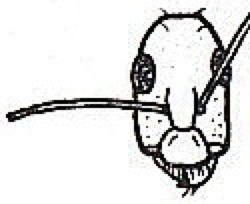 abjectus, aegyptiacus, aequatorialis, arnoldinus (?), baynei, cognatocompressus, congolensis, desantii, guttatus, kersteni, maculatus, negus, (rubripes), sexpunctatus (?), traegaordhi Seemingly equivalent to Ashmead's Tanaemyrmex and Forel's Myrmoturba |
maculatus-group - 1 |
| -- | Alitrunk profile with distinct angle (even if obtuse) between dorsum and declivity of propodeum | A2 |
| A2 | 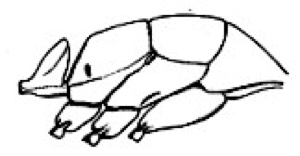 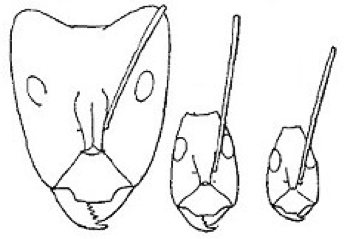 Majors
with clypeus with distinct median carina, a sharp anterior margin with
right angles laterally; large TL 15 mm plus; alitrunk
profile convex with angular propodeum, from above most with a
sub-rectangular posterior at transition to declivity; petiole scale
quite thick;
trimorphic (?) minors with distinct posteriorly narrowed heads; dark
red-brown to near black Majors
with clypeus with distinct median carina, a sharp anterior margin with
right angles laterally; large TL 15 mm plus; alitrunk
profile convex with angular propodeum, from above most with a
sub-rectangular posterior at transition to declivity; petiole scale
quite thick;
trimorphic (?) minors with distinct posteriorly narrowed heads; dark
red-brown to near black Minors with long scapes and legs; lighter brown-orange to yellow-red brevicollis, caffer, coniceps, crawleyi, donisthorpei, etiolipes, fornasinii (?), heros, knysnae, langi, natalensis, oasium, pompeius, posticus, probativus, wellmani, varus Seemingly equivalent to Ashmead's Dinomyrmex |
pompeius-group - 12 |
| -- | Minors with square to oval heads in full face view | A3 |
| A3 | 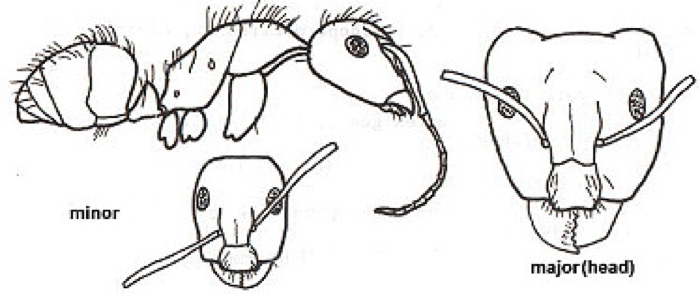 Large,
TL ca 15 mm; Minor head near rectangular Large,
TL ca 15 mm; Minor head near rectangularbrutus, buttikeri, empedocles (?), importunus, solon, somalinus Seemingly equivalent to Ashmead's Dinomyrmex |
brutus-group - 22 |
| -- | 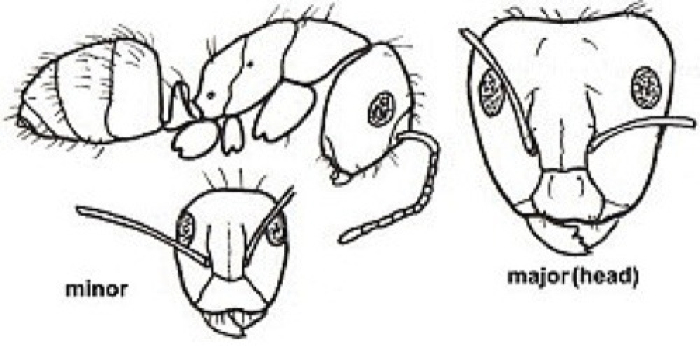 Small
(for genus) TL Major < 10 mm;
head with CI ca 100, occiput near straight, with gently rounded
corners, clypeus lacking a well-defined anterior lobe; alitrunk profile
interrupted shallowly convex but propodeum markedly
angular, from above
with a narrow posterior at transition to declivity; mostly dark near
black Small
(for genus) TL Major < 10 mm;
head with CI ca 100, occiput near straight, with gently rounded
corners, clypeus lacking a well-defined anterior lobe; alitrunk profile
interrupted shallowly convex but propodeum markedly
angular, from above
with a narrow posterior at transition to declivity; mostly dark near
blackMinor heads sub-ovoid to square acvapimensis, agonius, basuto, cleobulus, dicksoni, errabundus, immigrans, ligeus, maguassa, roubaudi, sacchii, thales, werthi |
acvapimensis-group - 26 |
|
|
||
| ¤ | Queen only known (possibly a pompeius-group member) | Zaïre - massinissa |
| ¤ | 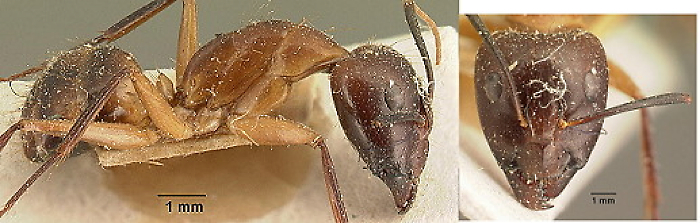 Not included in the
main key because the status of the
species (type location Madagascar) and its possible subspecies,
including those reported from South Africa, is far from clear Not included in the
main key because the status of the
species (type location Madagascar) and its possible subspecies,
including those reported from South Africa, is far from clear |
Madagascar and dubiously Southern Africa - hova |
| ¤ | In Paramyrmamblys; TL 9.0 mm | South Africa - bianconii |
| ¤ | 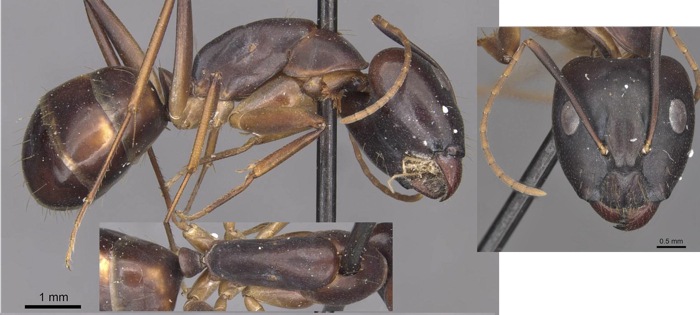 Media worker TL
8.5-9 mm & 7-8 mm, mostly dark brown Media worker TL
8.5-9 mm & 7-8 mm, mostly dark brown |
. |
| . | 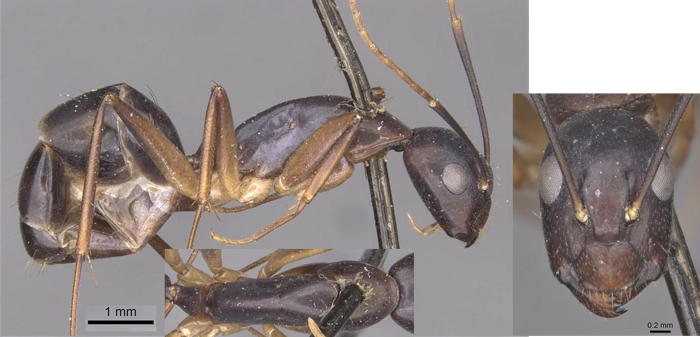 Minor Minor |
Tanzania - pulvinatus |
| ¤ | 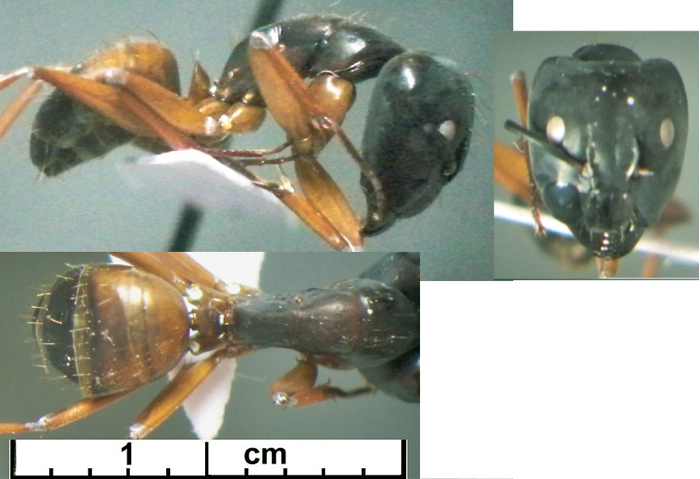 Major only described, TL ca 15-20 mm,
status uncertain
as description inadequate Major only described, TL ca 15-20 mm,
status uncertain
as description inadequate |
. |
| ¤ | 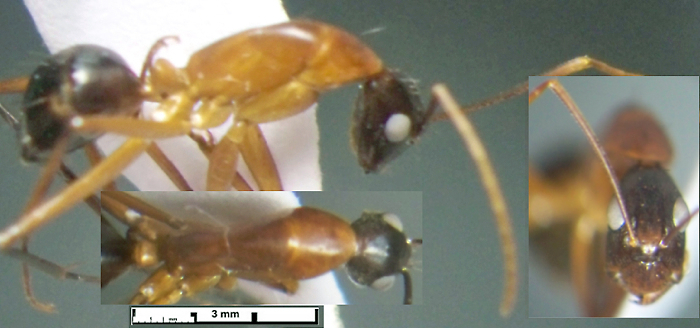 Minor from shared location in Liberia Minor from shared location in Liberia |
Sierra Leone & ? Liberia - rubripes |
| ¤ | 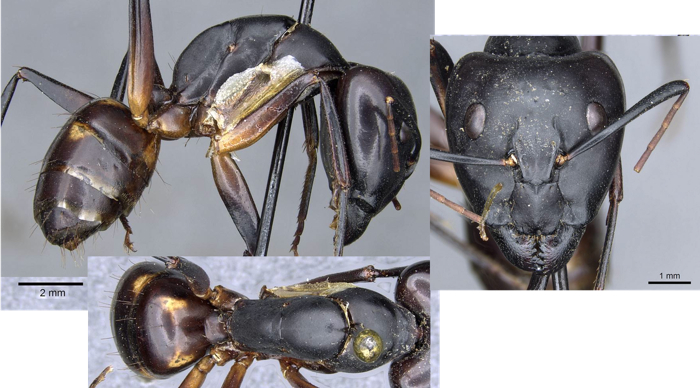 Queen ? Queen ? |
. |
| . | 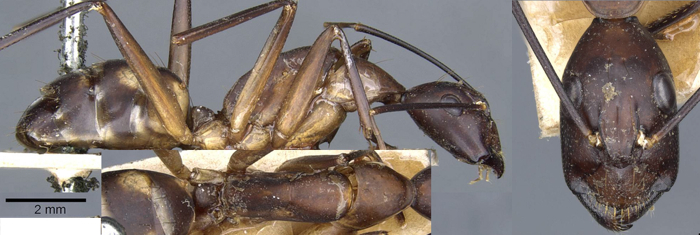 Minor Minor |
Mozambique - sexpunctatus |
| -- | Alitrunk profile convex in a smooth elongated curve;
at least dimorphic (?) minor/minima with head narrowed posteriorly but
not dramatically so and without any "neck" - maculatus-group |
-- |
| 1 | 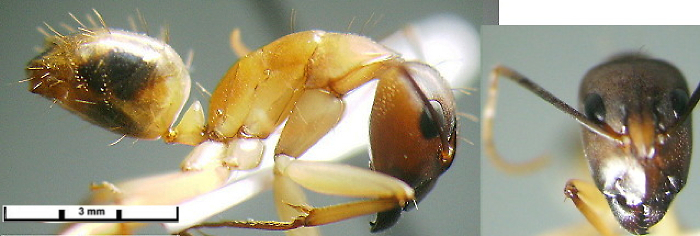 Majors
with heads longer than wide, approximately rectangular in full face
view with weakly arcuate sides and an only shallowly impressed
occipitum; maximum TL ca 10 mm; presently abjectus, guttatus,
kersteni, minisculus and proletaria Majors
with heads longer than wide, approximately rectangular in full face
view with weakly arcuate sides and an only shallowly impressed
occipitum; maximum TL ca 10 mm; presently abjectus, guttatus,
kersteni, minisculus and proletaria |
2 |
| -- | Majors
with head in full face view approximately triangular, with quite
strongly convex sides and deeply impressed occiptum - maculatus-complex |
4 |
| - | guttatus-complex | - |
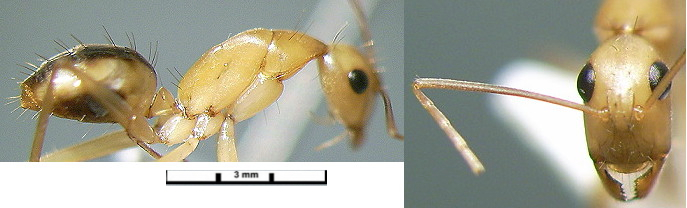
| 2 | 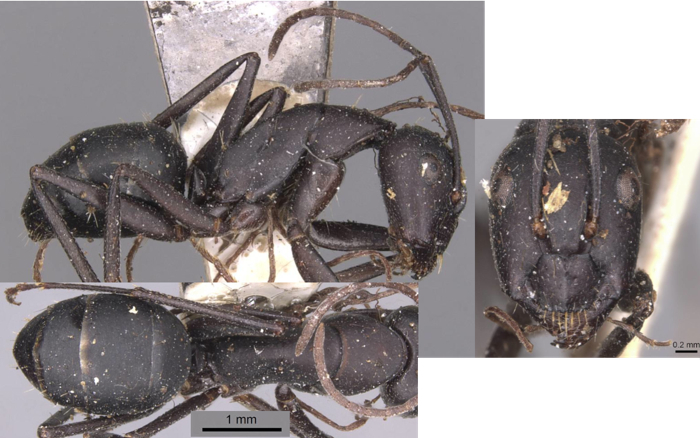 TL 5-6 mm; body and gaster
dark; gaster tergite margins with narrow pale bands; legs pale brown TL 5-6 mm; body and gaster
dark; gaster tergite margins with narrow pale bands; legs pale brown |
East Africa (? Guinea) - kersteni |
| -- | TL 8-9 mm | 3 |
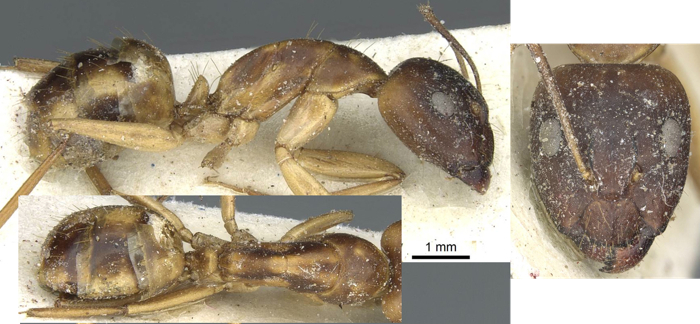
| 3 | 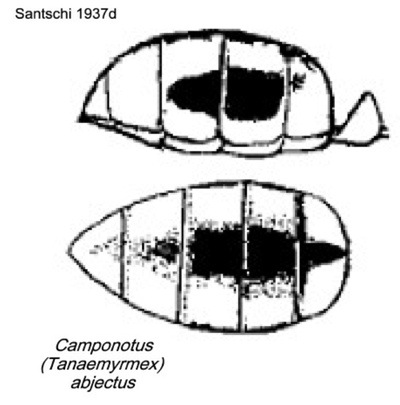 TL 8.5 mm; ground
colour pale yellow or yellow ochre, with
rust or red brown areas - distal mandibles, part of scapes, posterior
angles of head, bands at each suture of gaster; and dark brown areas -
mass of mandibles, rest of head, dorsal areas of thorax and gaster,
plus on sides of gaster; erect hairs rust but sparse except on gaster TL 8.5 mm; ground
colour pale yellow or yellow ochre, with
rust or red brown areas - distal mandibles, part of scapes, posterior
angles of head, bands at each suture of gaster; and dark brown areas -
mass of mandibles, rest of head, dorsal areas of thorax and gaster,
plus on sides of gaster; erect hairs rust but sparse except on gaster |
. |
| . |  Major Major |
. |
| . |  Minor Minor |
Angola; Guinea & Senegal - abjectus |
| -- | 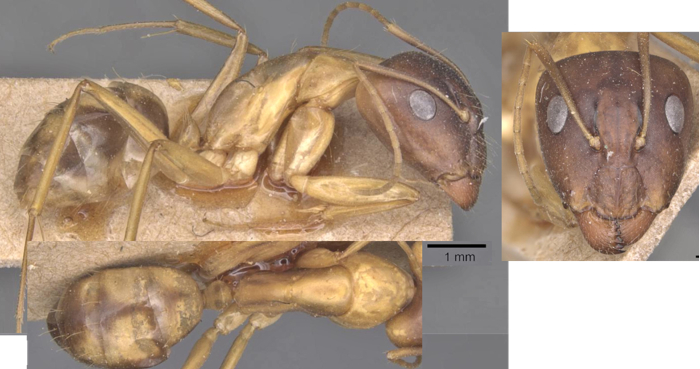 TL Major 8 mm; major
head HL 2.4 mm HW
2.0 mm; head distinctively shaped with sides only feebly arcuate;
clypeus carinate with the anterior margin feebly arcuate and the corner
right-angled; primarily yellow rust brown, head darker; from the
description appears similar to abjectus but has the front of
the face densely stippled (pointillé) and matt, the posterior of the
face and alitrunk being finely reticulate-striate but weakly shiny; the
scape is slender and surpasses the occiput TL Major 8 mm; major
head HL 2.4 mm HW
2.0 mm; head distinctively shaped with sides only feebly arcuate;
clypeus carinate with the anterior margin feebly arcuate and the corner
right-angled; primarily yellow rust brown, head darker; from the
description appears similar to abjectus but has the front of
the face densely stippled (pointillé) and matt, the posterior of the
face and alitrunk being finely reticulate-striate but weakly shiny; the
scape is slender and surpasses the occiput |
. |
| . | 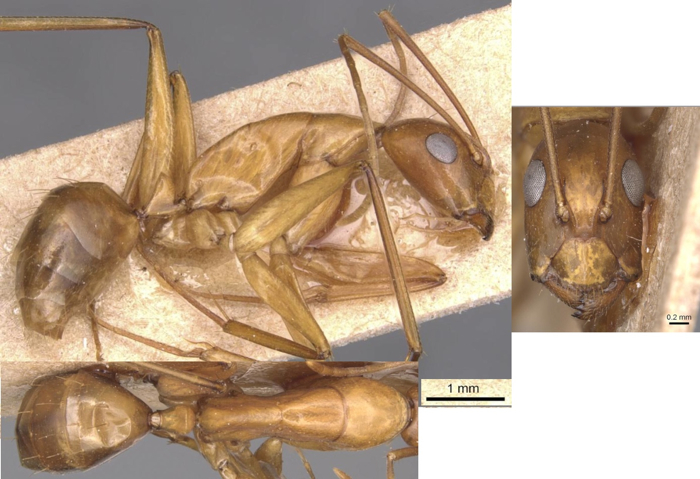 Minor
5.25-4 mm Minor
5.25-4 mm |
West Africa - guttatus |
| -- | 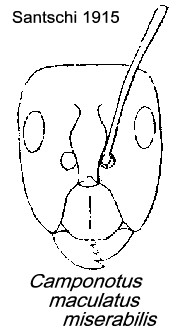 TL 9.0 mm; head black
or brownish, dorsal alitrunk and gaster reddish-brown; minor TL 6.5 mm,
head elongated TL 9.0 mm; head black
or brownish, dorsal alitrunk and gaster reddish-brown; minor TL 6.5 mm,
head elongated |
. |
| . | 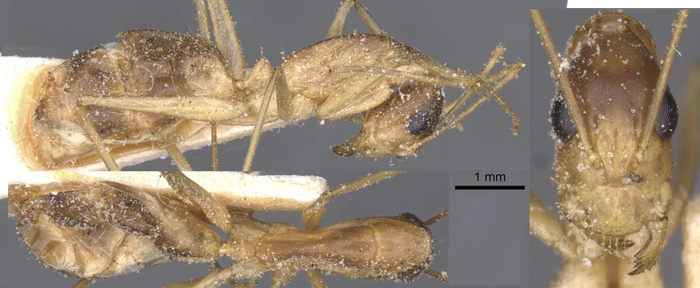 |
Guinea - proletaria |
| - | maculatus-complex | - |
| 4 | 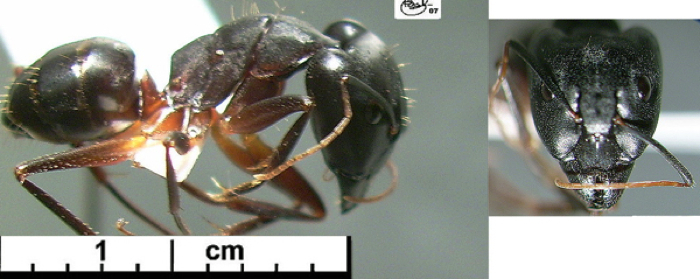 With at least a few
gular hairs on underside of head;
Major TL ca 15 mm; HW 4.3 HL 3.9 mm; mostly dark brown, alitrunk yellow
(particularly in minors), funiculus, petiole, rust patches on gaster With at least a few
gular hairs on underside of head;
Major TL ca 15 mm; HW 4.3 HL 3.9 mm; mostly dark brown, alitrunk yellow
(particularly in minors), funiculus, petiole, rust patches on gaster |
. |
| . | 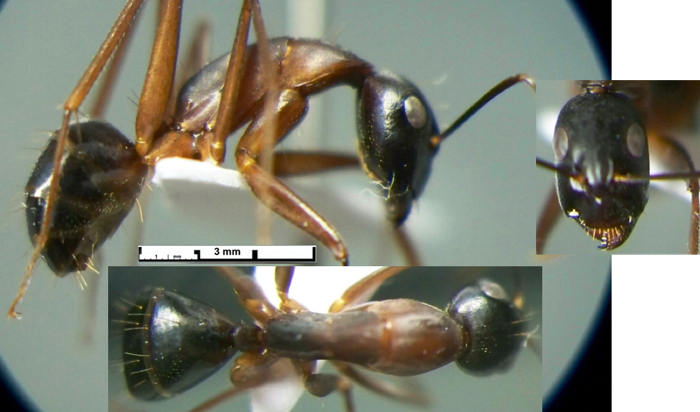 Minor Minor |
Sudan, Eritrea, Egypt - fellah |
| -- | Without any gular hairs on underside of head | 5 |
| 5 | TL < 11 mm | 6 |
| -- | TL > 11 mm | 8 |
| 6 | Head and body with substantial areas brown or lighter | 7 |
| -- | Head and whole body unicolorous black or nearly so | 7a |
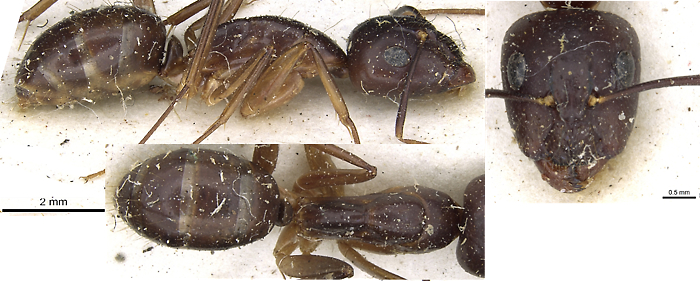
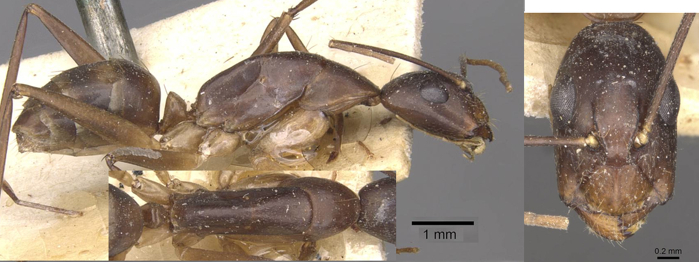
| 7 | 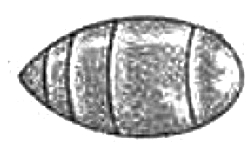 TL Major 10.5 mm,
Minor 7.5-8 mm; head less convex-sided
and less narrowed in front, occiput less impressed; scape surpasses
occiput by about one-third its own length; pilosity rusty red, sparse
on alitrunk and gaster, slightly more abundant on anterior of head;
head black, alitrunk and gaster brown, tibiae dark brown, mandibles
& scapes blackish, femora & tarsi pale brown, trochanters,
coxae, petiole and funiculus ochreous; margins of gaster segments
translucent ohcreous but lateral pale spots on first two segments very
dark and diffuse TL Major 10.5 mm,
Minor 7.5-8 mm; head less convex-sided
and less narrowed in front, occiput less impressed; scape surpasses
occiput by about one-third its own length; pilosity rusty red, sparse
on alitrunk and gaster, slightly more abundant on anterior of head;
head black, alitrunk and gaster brown, tibiae dark brown, mandibles
& scapes blackish, femora & tarsi pale brown, trochanters,
coxae, petiole and funiculus ochreous; margins of gaster segments
translucent ohcreous but lateral pale spots on first two segments very
dark and diffuse |
. |
| . |  |
. |
| . |  Minor (muger) Minor (muger) |
South Africa - traegaordhi |
| -- | 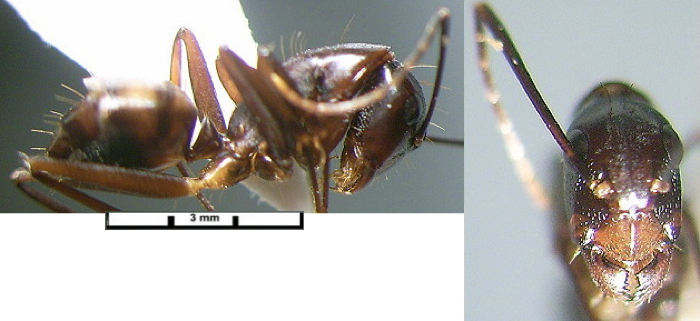 TL 8.9-11 mm;
mandibles with 6-7 teeth, subopaque, very
finely reticulate, with spaced puncturations; scapes strongly curved,
quite cylindrical, surpassing the occiput by about twice their width;
propodeal declivity a little shorter than the dorsum; tibia
subcylindrical, with two or three denticles apically and sides feebly
channeled; erect pilosity rust, quite long but sparse on the body, none
on the tibiae and tarsi, pubescence very fine, very short and very
spaced out all over; shiny, head, appendages and gaster brown black;
occipital angles, posterior clypeus and mandible apices, plus part of
the thorax of red brown; basal part of gaster, funiculi, base and apex
of scapes, lower legs and part of alitrunk yellow rust, narrow
transverse band on first gastral segment and base of mandibles brown. TL 8.9-11 mm;
mandibles with 6-7 teeth, subopaque, very
finely reticulate, with spaced puncturations; scapes strongly curved,
quite cylindrical, surpassing the occiput by about twice their width;
propodeal declivity a little shorter than the dorsum; tibia
subcylindrical, with two or three denticles apically and sides feebly
channeled; erect pilosity rust, quite long but sparse on the body, none
on the tibiae and tarsi, pubescence very fine, very short and very
spaced out all over; shiny, head, appendages and gaster brown black;
occipital angles, posterior clypeus and mandible apices, plus part of
the thorax of red brown; basal part of gaster, funiculi, base and apex
of scapes, lower legs and part of alitrunk yellow rust, narrow
transverse band on first gastral segment and base of mandibles brown. |
Congo Basin (?Guinea) - aequatorialis. |
| . |
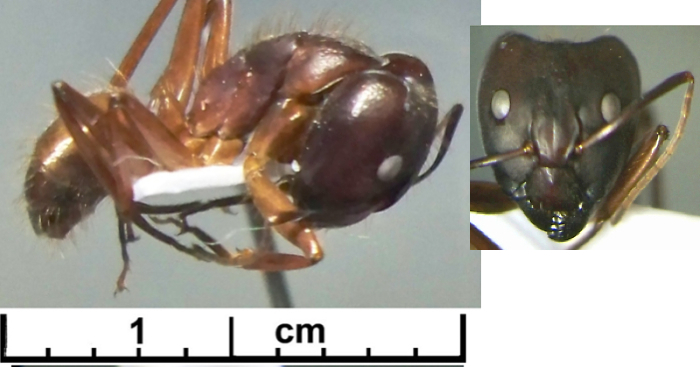 Speculatively, I have separated this as the major of the
kohli variety Speculatively, I have separated this as the major of the
kohli variety |
. |
| . |
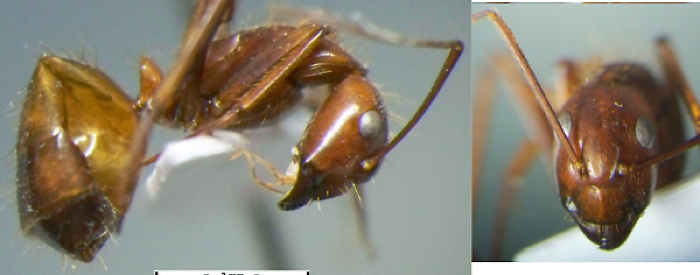 Speculatively, I have separated this as the minor of the
kohli variety Speculatively, I have separated this as the minor of the
kohli variety |
aequatorialis kohli |
| 7a | 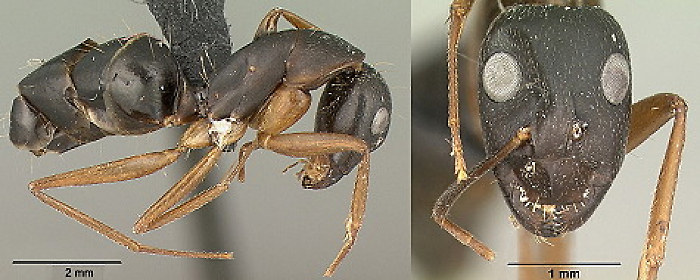 TL 9.5 mm; head
narrower anteriorly than maculatus;
petiole scale higher than long, twice as wide as high, subacuminate
above, anterior face near flat; dull black, alitrunk very dark
brownish-black, legs dark brown, apex of gastral segments translucent
testaceous TL 9.5 mm; head
narrower anteriorly than maculatus;
petiole scale higher than long, twice as wide as high, subacuminate
above, anterior face near flat; dull black, alitrunk very dark
brownish-black, legs dark brown, apex of gastral segments translucent
testaceous |
. |
| . | 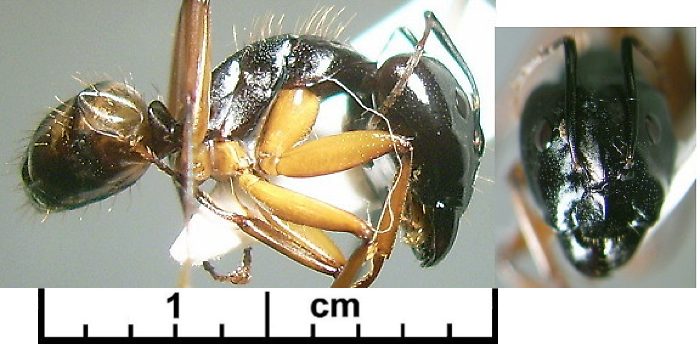 It seems negus
as presently understood
encompasses several forms of which this shiny Major may be one It seems negus
as presently understood
encompasses several forms of which this shiny Major may be one |
Ethiopia south to South Africa - negus |
| -- | 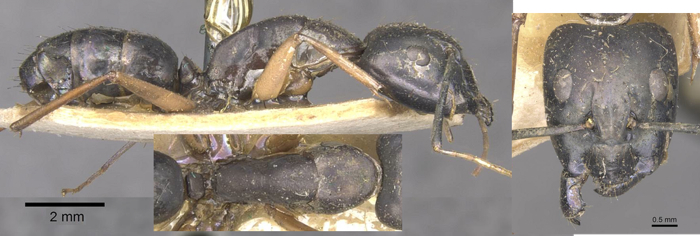 Major TL ca 12.5 mm; propodeum somewhat angular, dorsum
one-third
longer than declivity; black or blackish-brown, appendages reddish
ochreous (minor with alitrunk yellowish-brown) Major TL ca 12.5 mm; propodeum somewhat angular, dorsum
one-third
longer than declivity; black or blackish-brown, appendages reddish
ochreous (minor with alitrunk yellowish-brown) |
|
| . | 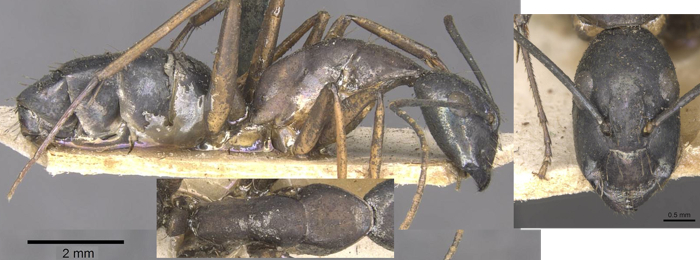 Minor Minor |
South Africa - arnoldinus |
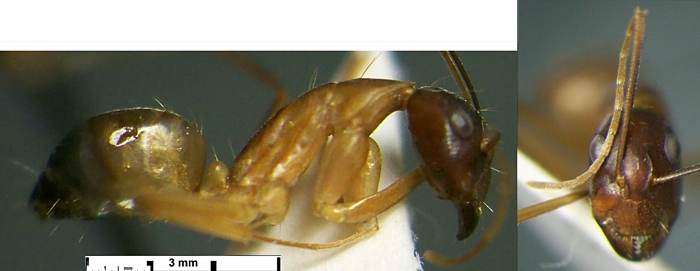
| -- | 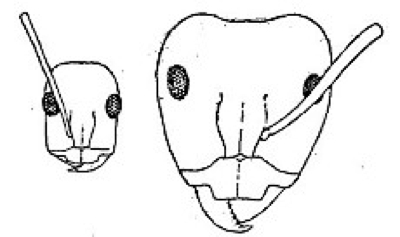 TL 10 mm;
dorsum of head and alitrunk opaque, remainder
shiny; black, appendages ferruginous, gaster with pale posterior margins TL 10 mm;
dorsum of head and alitrunk opaque, remainder
shiny; black, appendages ferruginous, gaster with pale posterior margins |
. |
| . | 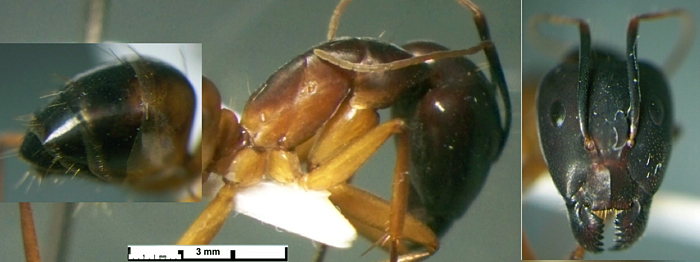 |
. |
| . |  |
Cape Verde Is & Senegal - occasus |
| - | TL > 11 mm | - |
| 8 | Hind tibiae without setae on the lower margin (or no more than one or two) | 9 |
| -- | Hind tibiae with at least five setae on the lower margin | 10 |
| 9 | 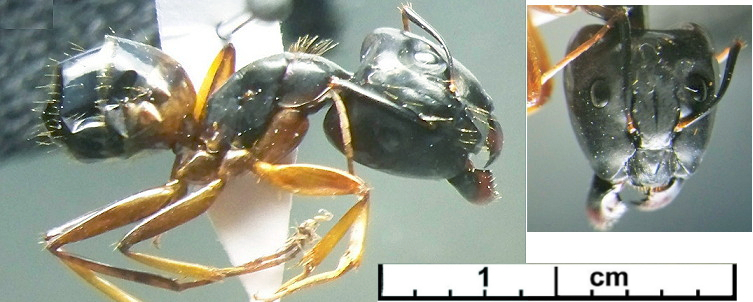 TL
15 mm TL
15 mm |
Central African Republic - new species - carensis |
| -- | TL > 12 mm | 9B |
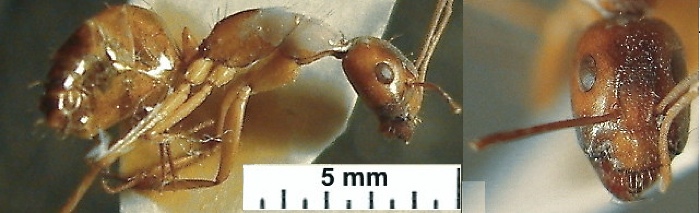
| 9B | 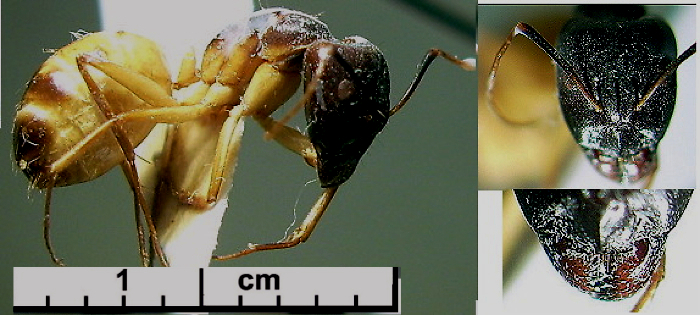 Major
TL > 11 mm; poly- or trimorphic, Major only moderately sized; head
& thorax uniformly dark brown, gaster with distinctive pattern of
yellow-brown patches, legs almost entirely yellow. Minors more
predominantly yellow brown; tibiae without setae Major
TL > 11 mm; poly- or trimorphic, Major only moderately sized; head
& thorax uniformly dark brown, gaster with distinctive pattern of
yellow-brown patches, legs almost entirely yellow. Minors more
predominantly yellow brown; tibiae without setae |
. |
| . |  |
Sahel zone - aegyptiacus |
| -- | 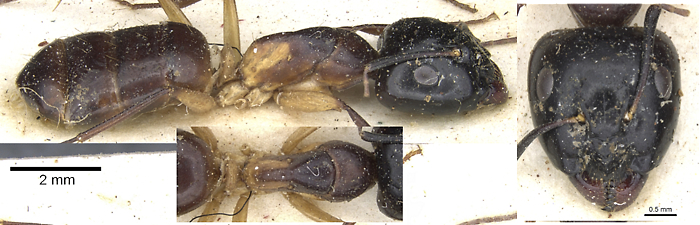 Major TL 10.8
mm; pilosity brownish-yellow; head and most
of body blackish-brown; petiole, coxae and femora ochreous; tibiae
without setae Major TL 10.8
mm; pilosity brownish-yellow; head and most
of body blackish-brown; petiole, coxae and femora ochreous; tibiae
without setae |
. |
| . | 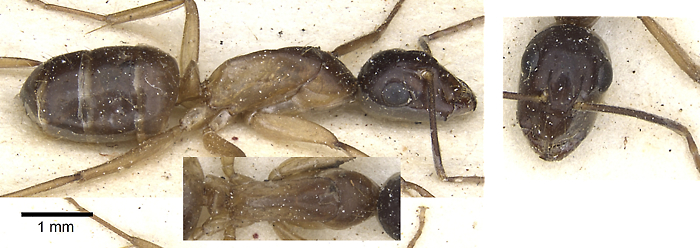 |
South Africa - baynei |
| -- | 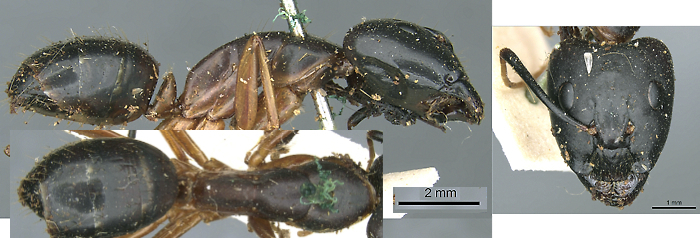 Major
TL > 11 mm; poly- or trimorphic, Major only moderately sized; head
& thorax uniformly dark brown, gaster entirely black. Minors
similarly coloured Major
TL > 11 mm; poly- or trimorphic, Major only moderately sized; head
& thorax uniformly dark brown, gaster entirely black. Minors
similarly coloured |
South Africa - cognatus |
| - | Hind tibiae with at least five setae on the lower margin | - |
| 10 | 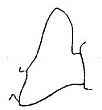 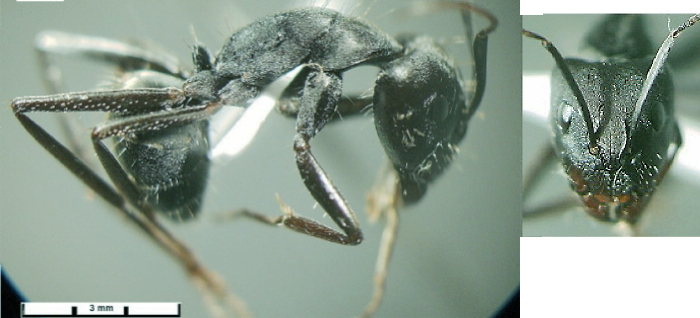 Major TL ca 13 mm;
head a little longer than wide, scape
not reaching occipital margin; clypeus with median carina; head &
alitrunk densely and finely reticulopunctate; petiole scale relatively
thick, intermediate between scale and cuneiform (right); overall black
with a silky appearance and a bluish tinge Major TL ca 13 mm;
head a little longer than wide, scape
not reaching occipital margin; clypeus with median carina; head &
alitrunk densely and finely reticulopunctate; petiole scale relatively
thick, intermediate between scale and cuneiform (right); overall black
with a silky appearance and a bluish tinge |
. |
| . |
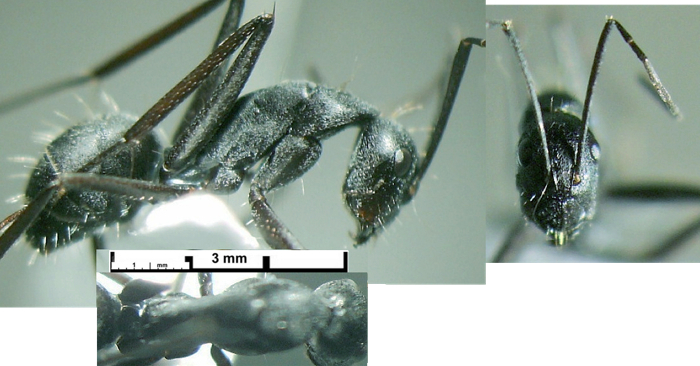 Minor Minor |
West Africa & Congo Basin - congolensis |
| -- | Major TL 14 mm plus | 11 |
| 11 | Very variable in
colour and size, enormously plastic
species; type form as in photomontage - the variability is analysed
separately from the species page; tibiae with setae on lower border |
. |
| . | 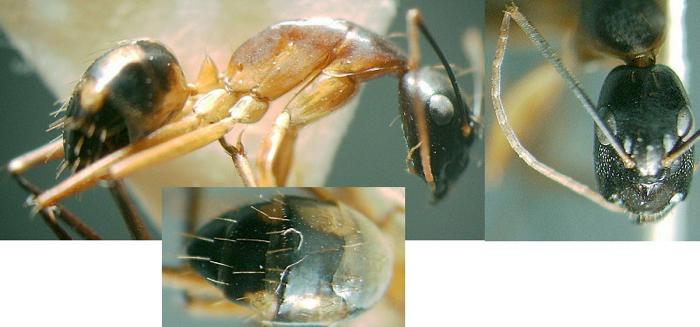 Minor Minor |
Pan-African, tramp - maculatus |
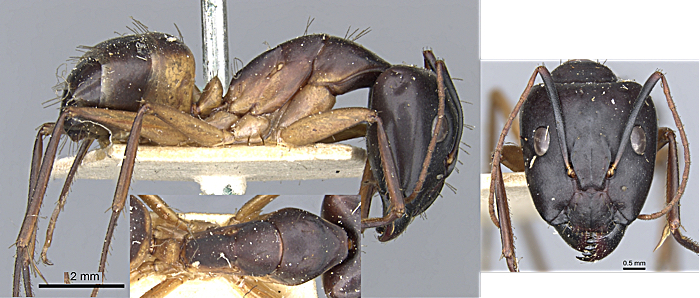
| -- | 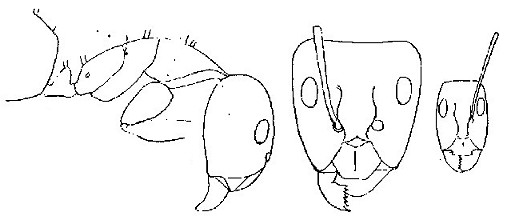 Major
TL 13 mm plus (estimate); HL 4.8 HW 3.5; head and thorax dorsum,
up to the upper part of the propodeal declivity, and dorsum of first
and second gastral segments black; funiculus, lower sides of thorax red
or brown rust; everything else yellow; tibiae with setae Major
TL 13 mm plus (estimate); HL 4.8 HW 3.5; head and thorax dorsum,
up to the upper part of the propodeal declivity, and dorsum of first
and second gastral segments black; funiculus, lower sides of thorax red
or brown rust; everything else yellow; tibiae with setae |
. |
| . |  |
. |
| . | 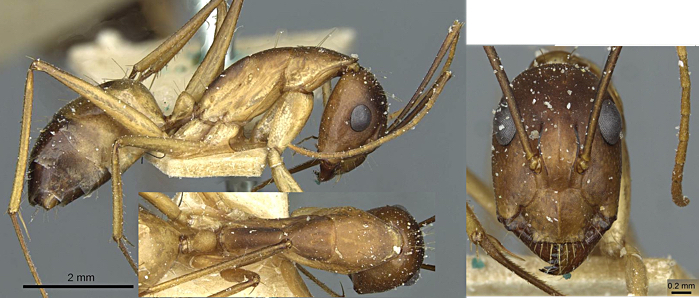 Minor TL ca 11.0 mm,
SL 2.8, posterior tibia 3.0;
alitrunk elongated Minor TL ca 11.0 mm,
SL 2.8, posterior tibia 3.0;
alitrunk elongated |
CAR & Benin - desantii |
| -- | 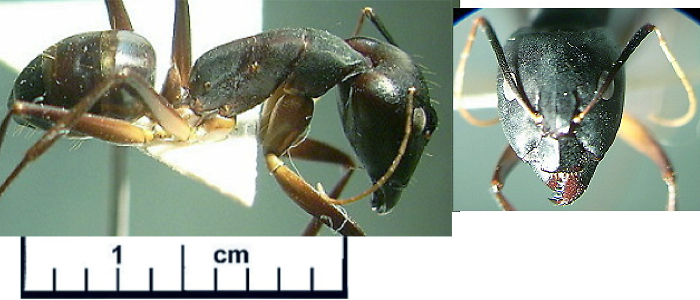 Probably
extra-limital, Major TL ca 15 mm, maculatus-group
but larger and strongly sculptured; head and alitrunk red-brown, gaster
near black Probably
extra-limital, Major TL ca 15 mm, maculatus-group
but larger and strongly sculptured; head and alitrunk red-brown, gaster
near black |
. |
| . | 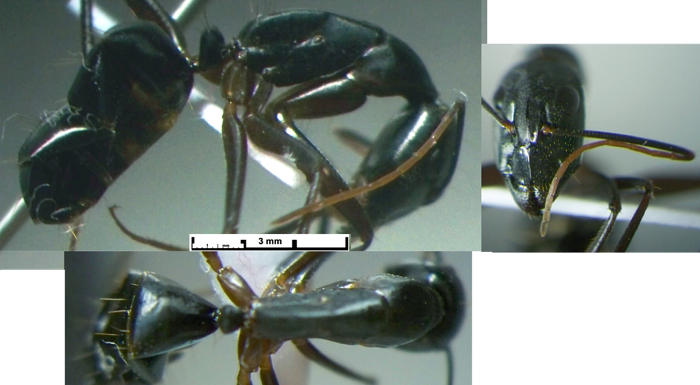 Minor Minor |
North Africa inc Egypt - cognatocompressus |
| -- | 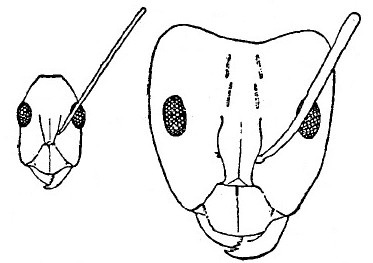 Major
TL 13 mm; tarsi flattened but not channeled; narrower more curved
mandibles and the rouned corners to the anterior margin of the clypeus
(sharp right angles in the type maculatus);
black, mandibles ferruginous; funiculi, coxae and base of femur
reddish-fulvous. Major
TL 13 mm; tarsi flattened but not channeled; narrower more curved
mandibles and the rouned corners to the anterior margin of the clypeus
(sharp right angles in the type maculatus);
black, mandibles ferruginous; funiculi, coxae and base of femur
reddish-fulvous. |
. |
| . | 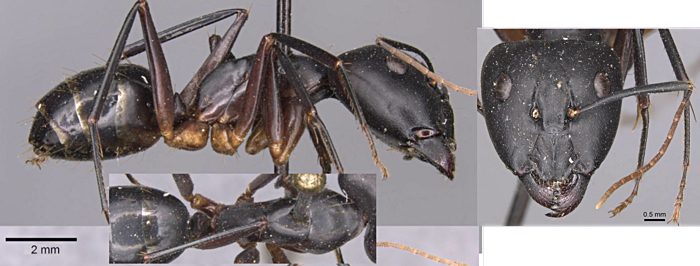 |
. |
| . | 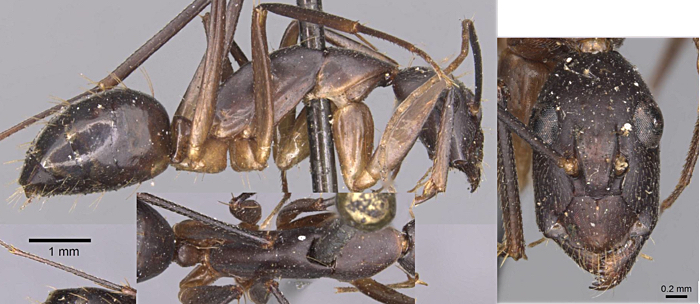 Minor TL ca 8-9 mm,
SL 3.0, posterior tibia 3.0; head shape is much shorter behind the eyes Minor TL ca 8-9 mm,
SL 3.0, posterior tibia 3.0; head shape is much shorter behind the eyes |
Uganda & Sudan - sarmentus |
 - - |
Alitrunk profile with distinct angle (even if obtuse) between dorsum and declivity of propodeum | - |
| 12 | Large
TL 15 mm plus; petiole scale quite thick, usually cuneiform; minors
with distinct posteriorly narrowed heads; Majors dark red-brown to
near black; Minors lighter brown-orange to yellow-red |
pompeius-group - 13 |
| - | miscellaneous species | - |
| 12a | 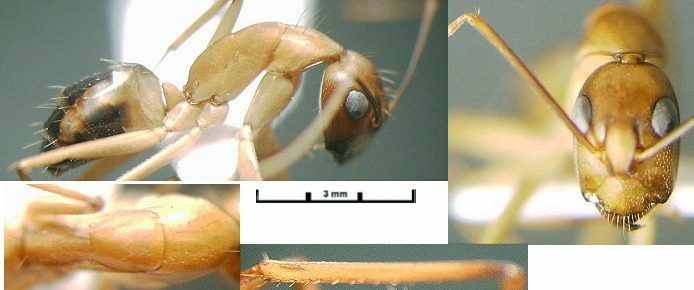 Major
TL 16 mm; Minor TL ca 7 mm; dorsum of petiole steeply rounded and with
a longitudinal weak impression (at least in minors); head large, domed
and short; appendages relatively short and slender; almost entirely
matt; major uniform reddish-brown, with the head and gaster often
blackish. Minors with prismatic tibiae which have a line of short
setae Major
TL 16 mm; Minor TL ca 7 mm; dorsum of petiole steeply rounded and with
a longitudinal weak impression (at least in minors); head large, domed
and short; appendages relatively short and slender; almost entirely
matt; major uniform reddish-brown, with the head and gaster often
blackish. Minors with prismatic tibiae which have a line of short
setae |
Sahel zone into western Asia - oasium |
| -- | 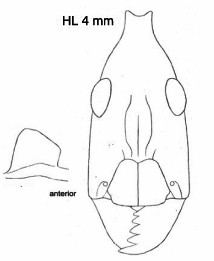 Minor only in original description; TL 15 mm (size similar
to etiolipes) Minor only in original description; TL 15 mm (size similar
to etiolipes) |
. |
| . | 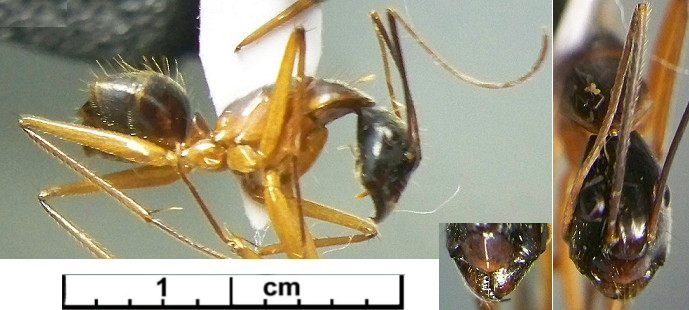 |
. |
| . | 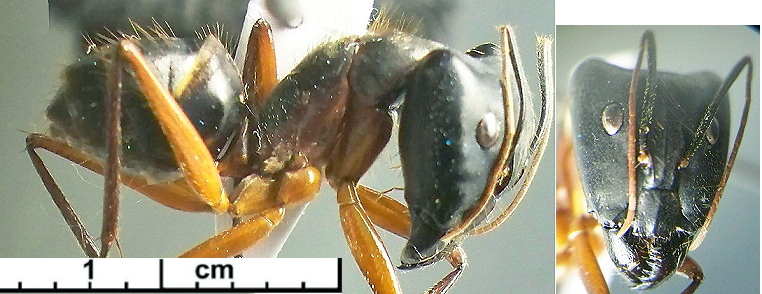 Major (new finding)
TL ca 18 mm, HW 5 HL 5.3 Major (new finding)
TL ca 18 mm, HW 5 HL 5.3 |
Congo Basin (north?) - brevicollis |
| . | 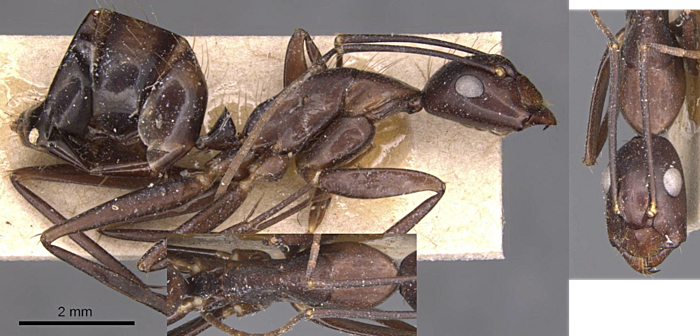 Minor
only; TL 8.5-9 mm, SL 3.1 mm; castaneous brown, with alitrunk and
appendages lighter; moderately dense erect hairs on alitrunk dorsum Minor
only; TL 8.5-9 mm, SL 3.1 mm; castaneous brown, with alitrunk and
appendages lighter; moderately dense erect hairs on alitrunk dorsum |
Cameroun & Congo - donisthorpei |
| -- | 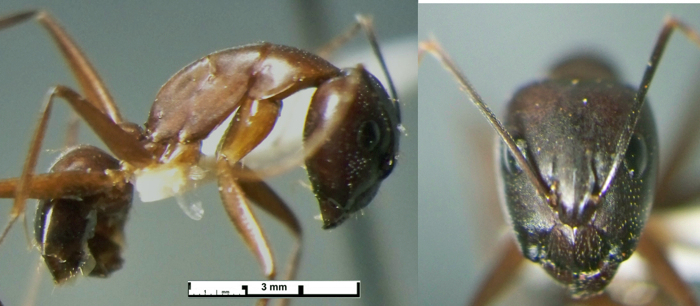 Major; TL ca 9.5 mm, SL 2.5; minor described as dull castaneous brown,
with alitrunk and
appendages lighter; lacking erect hairs on the dorsal alitrunk Major; TL ca 9.5 mm, SL 2.5; minor described as dull castaneous brown,
with alitrunk and
appendages lighter; lacking erect hairs on the dorsal alitrunk |
. |
| . | 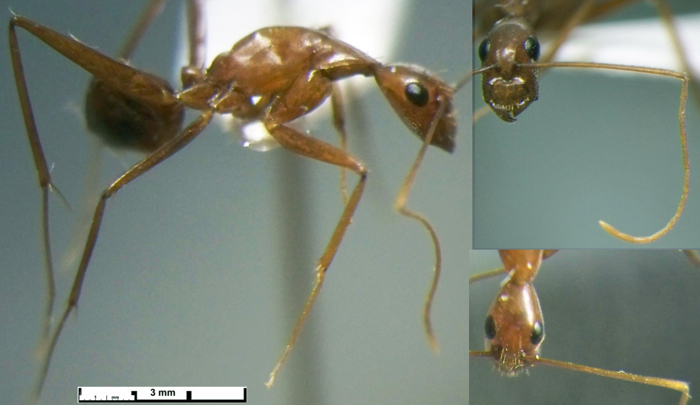 Minor
only; TL 8.5-9 mm, SL 3.1 mm; castaneous brown, with alitrunk and
appendages lighter Minor
only; TL 8.5-9 mm, SL 3.1 mm; castaneous brown, with alitrunk and
appendages lighter |
Cameroun & Congo - not donisthorpei |
| -- |
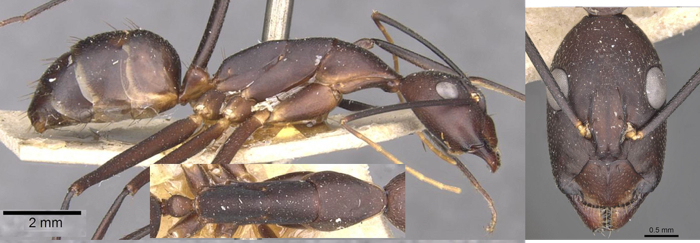 Minor only known, TL 11 to 12.5 mm; entirely dark brown;
alitrunk dorsum almost entirely lacking erect hairs Minor only known, TL 11 to 12.5 mm; entirely dark brown;
alitrunk dorsum almost entirely lacking erect hairs |
Angola - varus |
| - | pompeius-group | - |
| 13 | Head wider than long | 13a |
| -- | Head not wider than long | 14 |
| 13a | 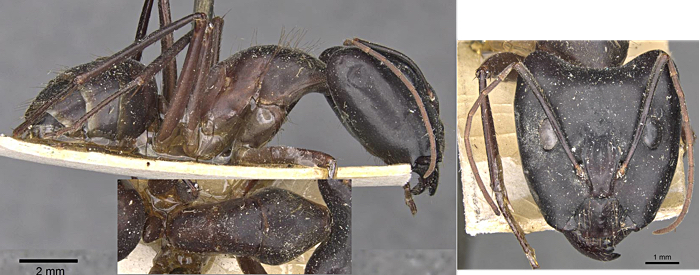 Major TL ca 18 mm;
head noticeably wider than long HW 6.5
HL 5.5; petiole scale convex on both sides; body with long silky dark
red hairs all over; basically brownish-black with slight brown tint,
appendages lighter; minor clypeus with distinctive anteriorly raised
median carina Major TL ca 18 mm;
head noticeably wider than long HW 6.5
HL 5.5; petiole scale convex on both sides; body with long silky dark
red hairs all over; basically brownish-black with slight brown tint,
appendages lighter; minor clypeus with distinctive anteriorly raised
median carina |
. |
| . | 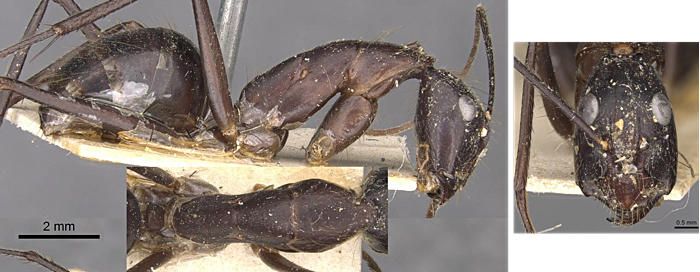 Minor
TL 12-13 mm, HL 3.0 SL 5; frontal area transverse, rhomboid; frontal
carinae close together, sinuous and slightly divergent; head regularly
narrowing from the anterior border to the occiput, sides regularly but
only mildly convex; eyes large and centered at mid-length of the head;
alitrunk elongated and slender, mildly convex; propodeum with declivity
shorter than dorsum; petiole scale cuneiform, convex on both faces,
near truncated at the summit, slightly higher than long; with long
silky, sharp, red brown hairs spaced across whole body, rising out of
punctules; pubescence sparse, fine, reddish, more abundant on the rear
of the head; tibiae and scapes with oblique short but abundant rusty
pilosity. Minor
TL 12-13 mm, HL 3.0 SL 5; frontal area transverse, rhomboid; frontal
carinae close together, sinuous and slightly divergent; head regularly
narrowing from the anterior border to the occiput, sides regularly but
only mildly convex; eyes large and centered at mid-length of the head;
alitrunk elongated and slender, mildly convex; propodeum with declivity
shorter than dorsum; petiole scale cuneiform, convex on both faces,
near truncated at the summit, slightly higher than long; with long
silky, sharp, red brown hairs spaced across whole body, rising out of
punctules; pubescence sparse, fine, reddish, more abundant on the rear
of the head; tibiae and scapes with oblique short but abundant rusty
pilosity. |
Southern Africa & Congo Basin (Guinea?) - wellmani |
| ¤ | 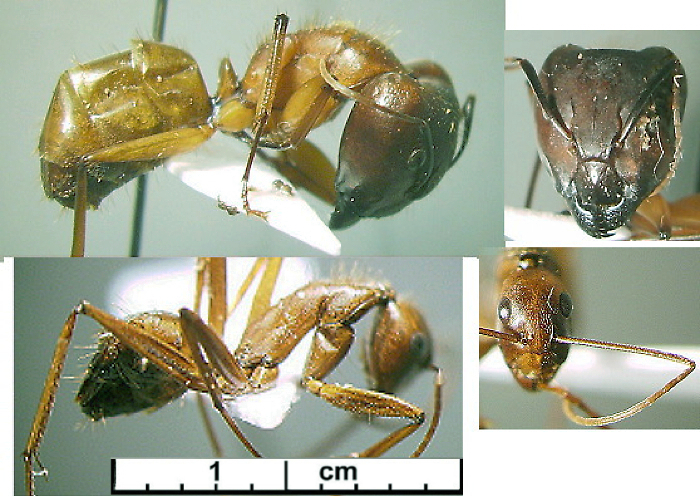 Minor only described, TL 8.5
mm; Major (new specimens) TL > 15 mm Minor only described, TL 8.5
mm; Major (new specimens) TL > 15 mm |
Cameroun - crawleyi |
| ¤ | 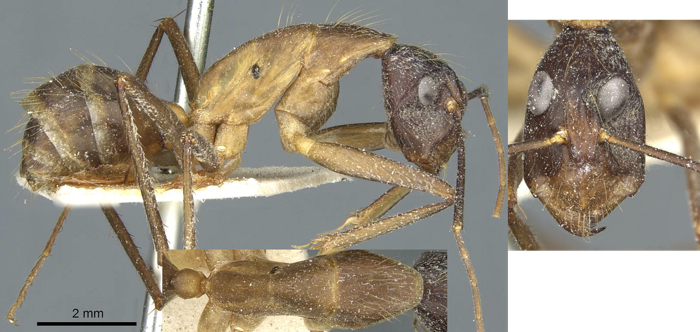 Minor TL 11 mm; head
conical narrowing behind the eyes (as wellmani, but much
shorter); clypeus with strong median carina; eyes somewhat bigger and
more convex; matt and densely transversely striate; whole body with
long quite abundant rust pilosity; head & scapes dark red-brown;
rest progressively lighter rearwards, gaster with lateral yellow
border. Minor TL 11 mm; head
conical narrowing behind the eyes (as wellmani, but much
shorter); clypeus with strong median carina; eyes somewhat bigger and
more convex; matt and densely transversely striate; whole body with
long quite abundant rust pilosity; head & scapes dark red-brown;
rest progressively lighter rearwards, gaster with lateral yellow
border. |
Congo - coniceps |
| 14 | Scapes surpassing occiput by at least one-quarter of own length or more | 15 |
| -- | Scape not reaching or only just surpassing occiput | 19 |
| 15 | 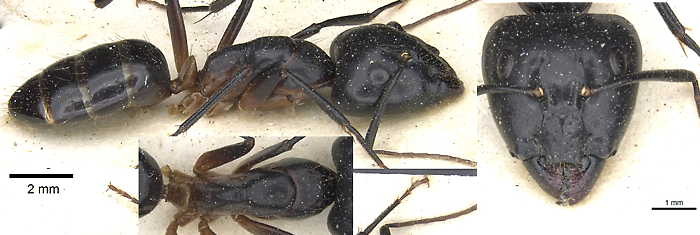 Scapes surpass occiput by
one-quarter of own length; Major TL 15.5-16.3 mm; head triangular
posteriorly widest and twice width at anterior margin; eyes set about
mid-point of head; tibiae compressed; mandibles shiny but coarsely
punctured; erect hairs fulvous sparse on head and alitrunk quite
abundant on gaster; head and alitrunk nitidulous gaster shiny; black
but funiculus, lower lateral alitrunk, petiole and basal third of
femora translucent testaceous Scapes surpass occiput by
one-quarter of own length; Major TL 15.5-16.3 mm; head triangular
posteriorly widest and twice width at anterior margin; eyes set about
mid-point of head; tibiae compressed; mandibles shiny but coarsely
punctured; erect hairs fulvous sparse on head and alitrunk quite
abundant on gaster; head and alitrunk nitidulous gaster shiny; black
but funiculus, lower lateral alitrunk, petiole and basal third of
femora translucent testaceous |
. |
| . | 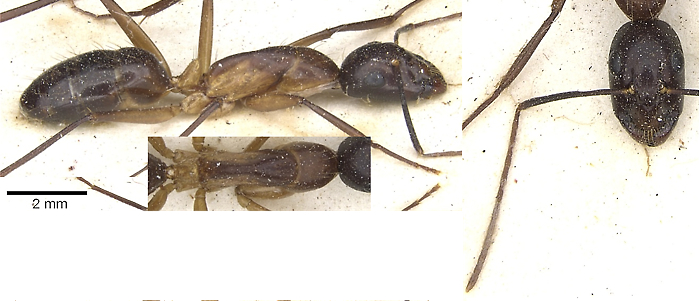 |
South Africa - knysnae |
| -- | Scapes surpassing occiput by at least one third of own length | 16 |
| 16 | 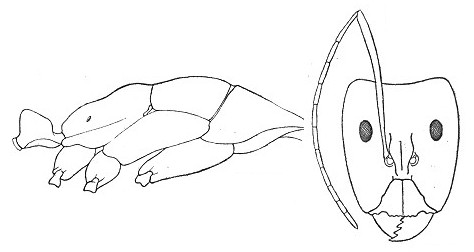 Major
TL 12.5-14 mm; overall shape narrow and elongated; head dark brown,
body brown, petiole and legs yellow-brown Major
TL 12.5-14 mm; overall shape narrow and elongated; head dark brown,
body brown, petiole and legs yellow-brown |
. |
| . | 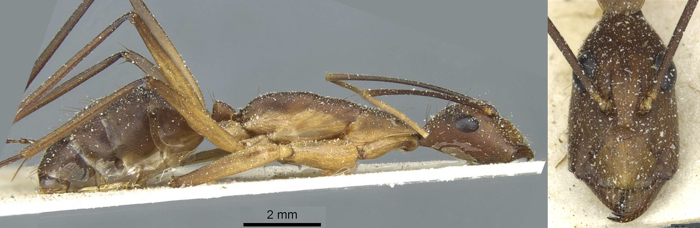 Minor Minor |
Zaïre (Madagascar?) - langi |
| -- | TL > 14 mm | 17 |
| 17 | 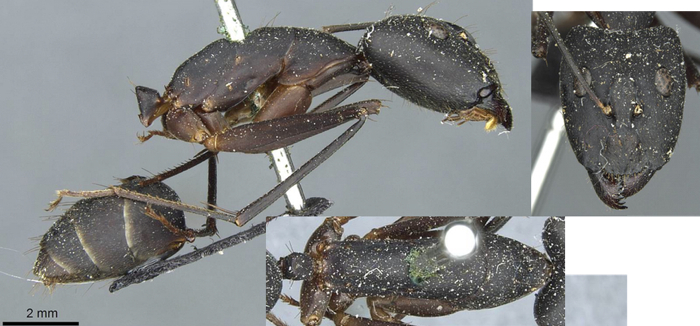 Major TL 16 mm, HL 4.7 HW 3.6;
(cf etiolipes, sic longipes but more slender and
slimmer) eyes quite large set at two-thirds point of head; petiole
higher than long; matt, head finely and densely reticulo-punctate,
gaster transversely shagreened; body with long golden red erect hairs,
those on gaster directed posteriorly; all over very fine rust short
pubescence; brownish-black, gaster segments narrowly bordered yellow,
funiculus, condylar bulbs, ends of scapes, trochanters, lower femora
and petiole, hind tarsi and apex of gaster rust Major TL 16 mm, HL 4.7 HW 3.6;
(cf etiolipes, sic longipes but more slender and
slimmer) eyes quite large set at two-thirds point of head; petiole
higher than long; matt, head finely and densely reticulo-punctate,
gaster transversely shagreened; body with long golden red erect hairs,
those on gaster directed posteriorly; all over very fine rust short
pubescence; brownish-black, gaster segments narrowly bordered yellow,
funiculus, condylar bulbs, ends of scapes, trochanters, lower femora
and petiole, hind tarsi and apex of gaster rust |
Tanzania - heros |
| -- | Eyes set at or just behind mid-point of face | 18 |
| 18 | 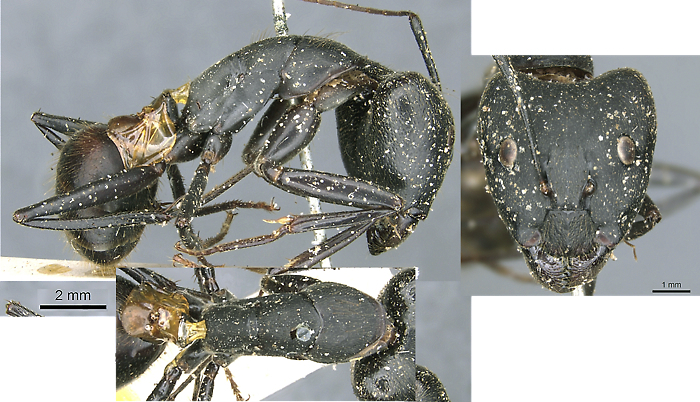 Major TL 14-17 mm; head
one-eighth longer than wide; eyes set just behind mid-point; alitrunk
profile with mesonotum more convex and raised above level of hind
margin of pronotum; entirely dull, relatively coarsely sculptured;
whole body, legs and antennae with fairly long abundant reddish yellow
pubescence; erect hairs long, fulvous and fairly plentiful, absent from
genae; black, apical borders of gaster narrowly testaceous and
translucent, funiculus and tarsi dark brown Major TL 14-17 mm; head
one-eighth longer than wide; eyes set just behind mid-point; alitrunk
profile with mesonotum more convex and raised above level of hind
margin of pronotum; entirely dull, relatively coarsely sculptured;
whole body, legs and antennae with fairly long abundant reddish yellow
pubescence; erect hairs long, fulvous and fairly plentiful, absent from
genae; black, apical borders of gaster narrowly testaceous and
translucent, funiculus and tarsi dark brown |
South Africa - natalensis |
| -- | 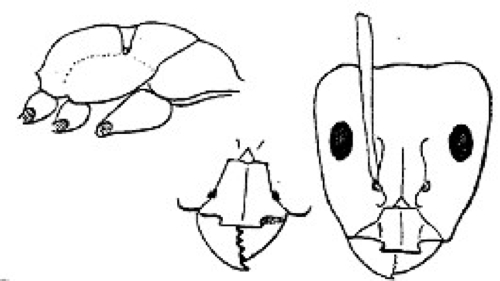 Major
TL 16-18 mm, HL = HW; sides of head not very convex; petiole with very
convex anterior and flat posterior; tibiae strongly compressed, dorsal,
inner and outer faces canaliculate; pilosity brownish-red, absent from
legs, very sparse on head; black, petiole dark yellowish brown,
appendages dull reddish-ochreous, gaster with a small dull ochreous
spot on each side of three basal segments Major
TL 16-18 mm, HL = HW; sides of head not very convex; petiole with very
convex anterior and flat posterior; tibiae strongly compressed, dorsal,
inner and outer faces canaliculate; pilosity brownish-red, absent from
legs, very sparse on head; black, petiole dark yellowish brown,
appendages dull reddish-ochreous, gaster with a small dull ochreous
spot on each side of three basal segments |
. |
| . | 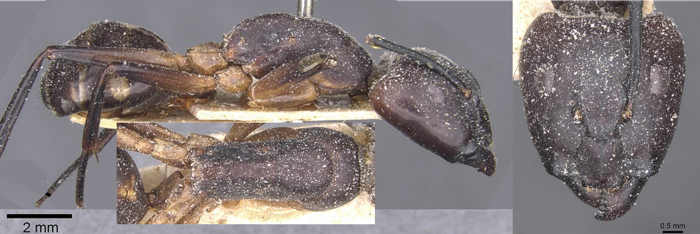 Major Major |
Mozambique - probativus |
| - | Major scape not reaching or hardly surpassing occiput | - |
| 19 | TL ca 15 mm | 20 |
| -- | TL > 15 mm | 21 |
| 20 | 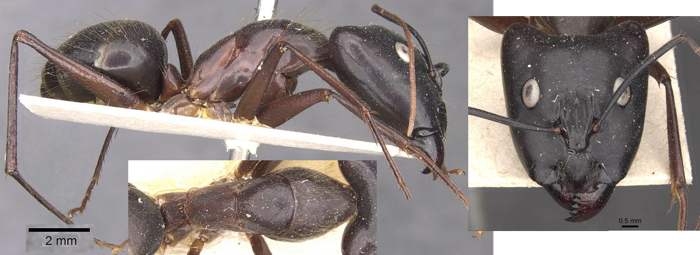 TL 15 mm; dark brown TL 15 mm; dark brown |
. |
| . | minor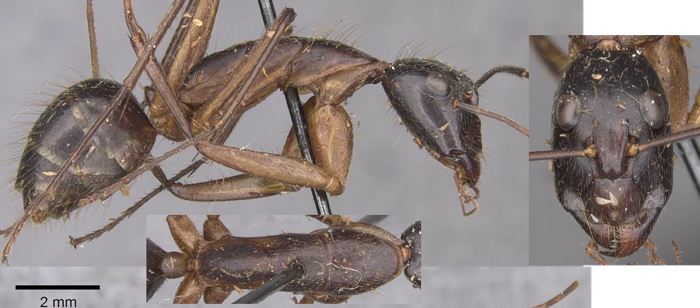 |
West Africa & Congo Basin - pompeius |
| -- | 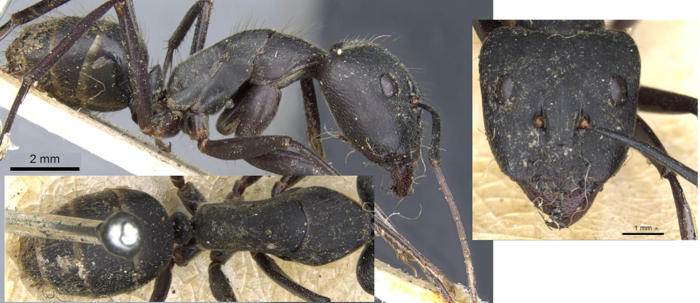 TL 15 mm, head near square, HW 4.2 HL 4.3; cf cognatus
head wider less narrowed in front, without erect hairs on genae; long
fine decumbent pubescence all over but sparse; tibiae with numerous
ventral setae TL 15 mm, head near square, HW 4.2 HL 4.3; cf cognatus
head wider less narrowed in front, without erect hairs on genae; long
fine decumbent pubescence all over but sparse; tibiae with numerous
ventral setae |
Mozambique - fornasinii |
| 21 | 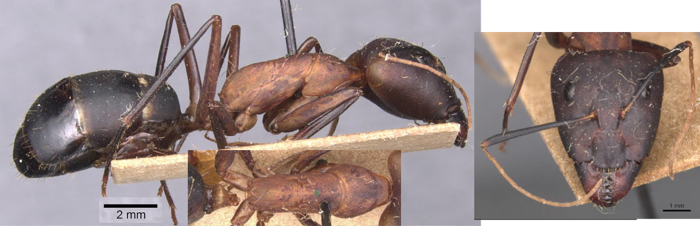 TL 16
mm; head, alitrunk and petiole fuscous, gaster with basal segments with
a small spot laterally, appendages dark rust; dull, scantily pilose and
scarcely pubescent TL 16
mm; head, alitrunk and petiole fuscous, gaster with basal segments with
a small spot laterally, appendages dark rust; dull, scantily pilose and
scarcely pubescent |
. |
| . | 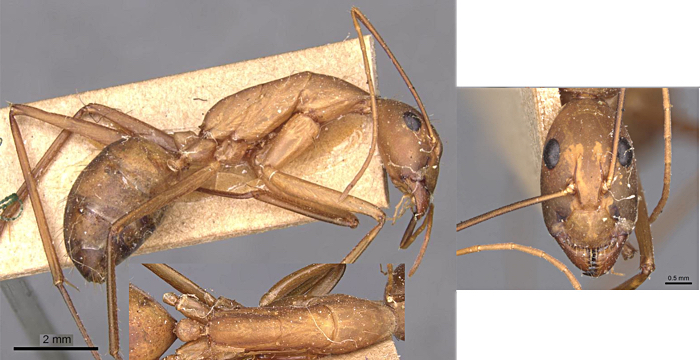 |
South Africa - caffer |
| -- | 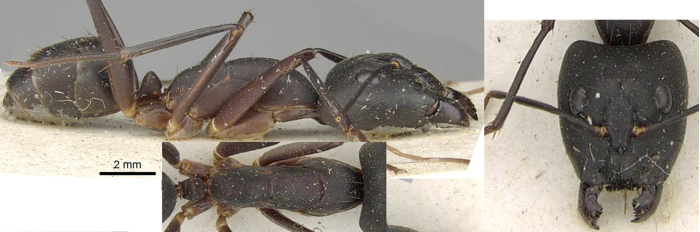 TL
major ca 16-17 mm?, minor 15.5-16 mm; major morphology like maculatus
rel to minor; head much longer than maculatus deeply emarginate
posteriorly; dull, finely shagreened and punctured, clypeus
with numerous hairs pits; major almost totally coal-black,
appendages piceous to reddish-brown TL
major ca 16-17 mm?, minor 15.5-16 mm; major morphology like maculatus
rel to minor; head much longer than maculatus deeply emarginate
posteriorly; dull, finely shagreened and punctured, clypeus
with numerous hairs pits; major almost totally coal-black,
appendages piceous to reddish-brown |
. |
| -- | 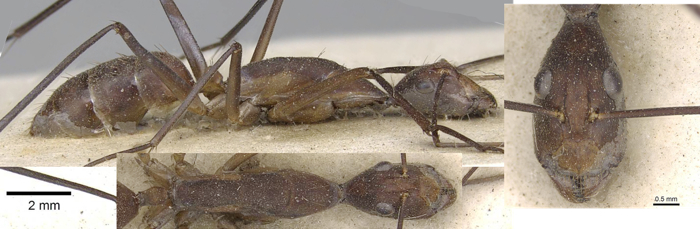 |
Southern Africa tropical forests - etiolipes |
| -- | 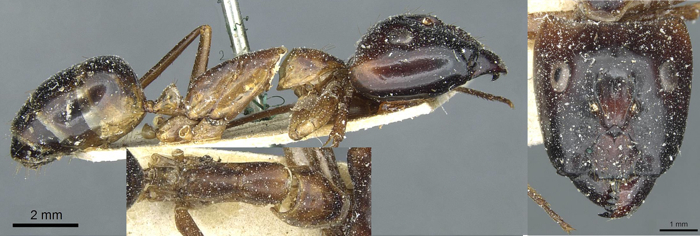 Very large, Major TL > 16 mm; Minor ca 10.5; erect
pilosity very long, sparse on alitrunk; colour predominantly
yellow-brown Very large, Major TL > 16 mm; Minor ca 10.5; erect
pilosity very long, sparse on alitrunk; colour predominantly
yellow-brown |
. |
| . | 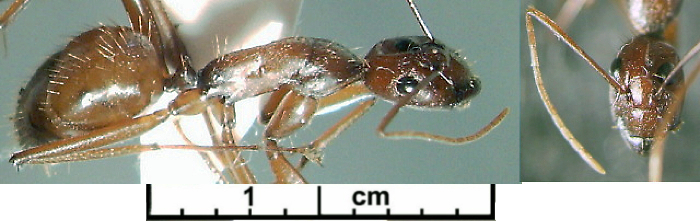 minor minor |
eastern Zaïre & Kenya - posticus |
| -- | 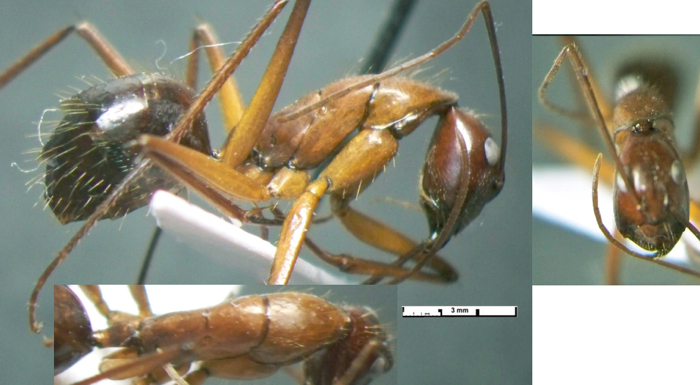 Minor
TL ca 13.0-14.5 mm; with long legs and antennae; fairly uniform
reddish-brown, gaster variably darker; petiole scale in profile broadly
triangular, in front view with a rounded apex Minor
TL ca 13.0-14.5 mm; with long legs and antennae; fairly uniform
reddish-brown, gaster variably darker; petiole scale in profile broadly
triangular, in front view with a rounded apex |
Angola, Cameroun,. Congo - Camponotus (Myrmoxygenys) caesar |
| -- | 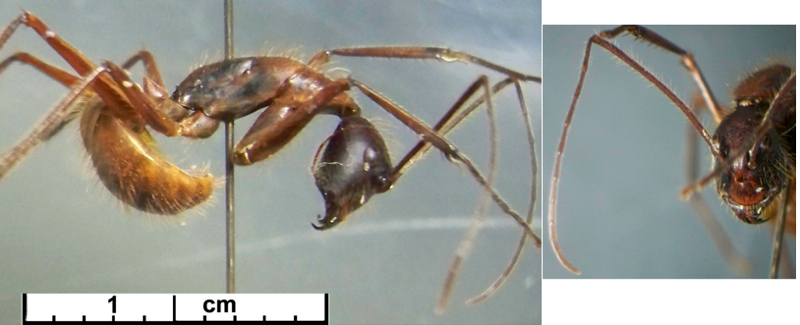 Minor;
TL 14.5-15.5 mm; sharply contrasting dark head, often with dark legs;
petiole scale in profile narrowly triangular, in front view with a
sharp apex Minor;
TL 14.5-15.5 mm; sharply contrasting dark head, often with dark legs;
petiole scale in profile narrowly triangular, in front view with a
sharp apex |
Cameroun - Camponotus
(Myrmoxygenys) caesar imperator |
| - |
Minors with square to ovoid faces | - |
| 22 | Large, TL > 12 mm; Minor head near rectangular - brutus, buttikeri, empedocles (?), importunus, solon | brutus-group - 23 |
| -- | Smaller, TL Major < 10 mm; Minor heads
sub-ovoid to square; alitrunk profile interrupted shallowly convex but
propodeum markedly angular; mostly dark near black |
acvapimensis-group - 26 |
| 23 | TL < 14 mm | 24 |
| -- | TL > 14 mm | 25 |
| 24 | 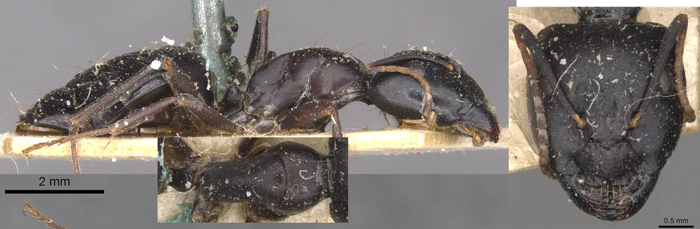 TL 10.0-13.6 mm; cf thales
but head with more prominent strongly angular occipital lobes, also
more distinctly punctured in front of eyes and below frontal carinae;
scapes just failing to reach occiptum; all black except apical margins
of gaster testaceous, legs and scapes dark brown TL 10.0-13.6 mm; cf thales
but head with more prominent strongly angular occipital lobes, also
more distinctly punctured in front of eyes and below frontal carinae;
scapes just failing to reach occiptum; all black except apical margins
of gaster testaceous, legs and scapes dark brown |
. |
| . | 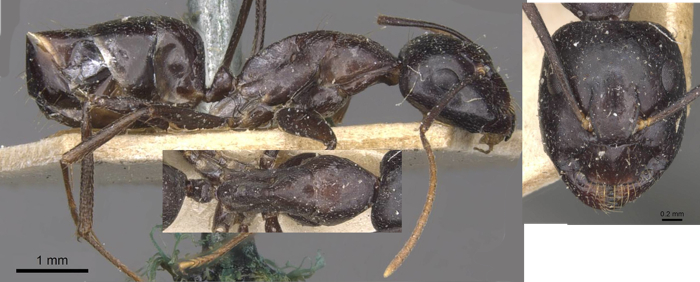 Minor Minor |
Southern Africa - empedocles |
| -- | 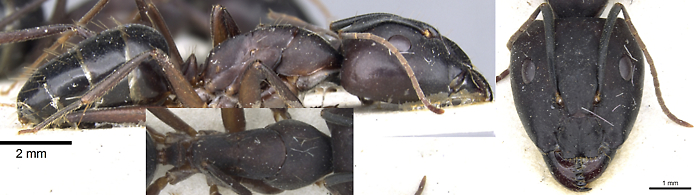 Major
TL 13 mm (cf natalensis but smaller); head highly domed in
anterior view; scapes reach occiput; very small petiole scale; head and
alitrunk dull due to microscopic reticulation, mandibles shiny; black
appendages rust or lighter Major
TL 13 mm (cf natalensis but smaller); head highly domed in
anterior view; scapes reach occiput; very small petiole scale; head and
alitrunk dull due to microscopic reticulation, mandibles shiny; black
appendages rust or lighter |
. |
| . | South Africa - buttikeri | |
| 25 | 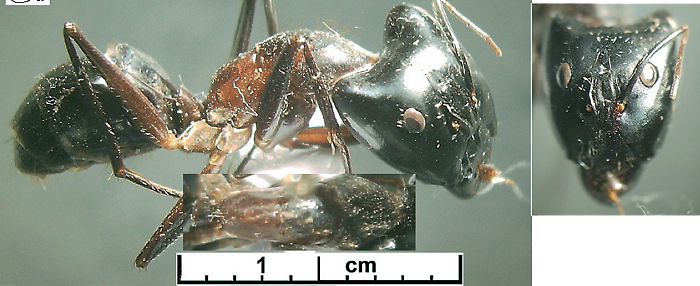 Major TL 18 mm; HW
significantly less than HL; colour
generally like solon but larger and with shiny smooth
mandibles; legs with abundant semi-decumbent short hairs Major TL 18 mm; HW
significantly less than HL; colour
generally like solon but larger and with shiny smooth
mandibles; legs with abundant semi-decumbent short hairs |
. |
| . | 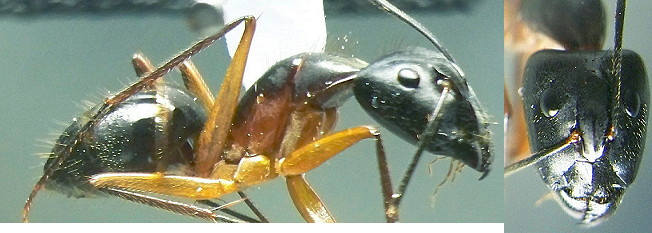 Media/minor, TL ca 14
mm Media/minor, TL ca 14
mm |
West Africa & Congo Basin - lycurgus |
| -- | Major HW near equal to HL | 25a |
| 25a |  Major TL
> 15 mm; head distinctly wider than long; declivity of propodeum
obtusely angled, petiole with blunt dorsal border; occiput with
numerous piliferous points, mandibles smooth; dark red-brown,
extremities orange Major TL
> 15 mm; head distinctly wider than long; declivity of propodeum
obtusely angled, petiole with blunt dorsal border; occiput with
numerous piliferous points, mandibles smooth; dark red-brown,
extremities orange |
. |
| . |  media/minor media/minor |
Western Africa (Angola to Sierra Leone) - brutus |
| -- | 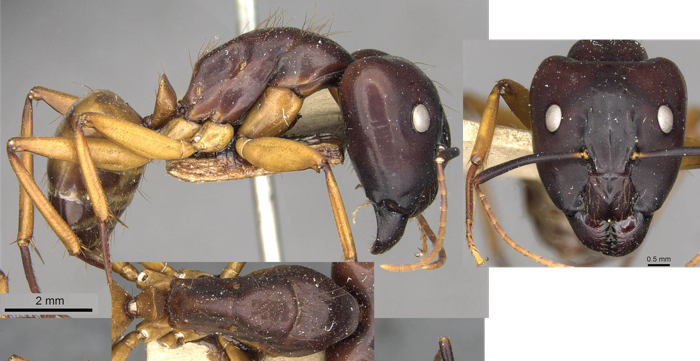 Major TL 15 mm;
head just longer than wide, petiole
with sharp dorsal border; mandibles striated, occiput smooth; dark
brown, head near black Major TL 15 mm;
head just longer than wide, petiole
with sharp dorsal border; mandibles striated, occiput smooth; dark
brown, head near black |
. |
| . | 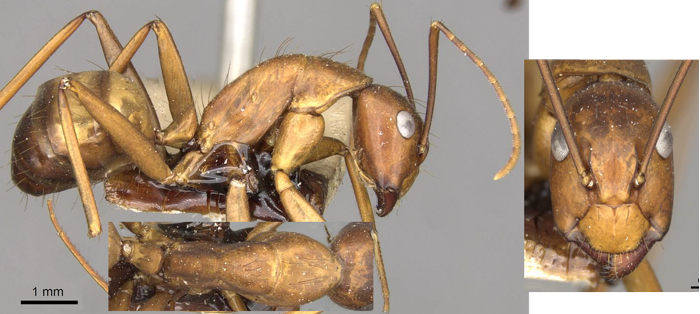 Media/minor Media/minor |
Angola and Congo Basin - solon |
| --NEW | 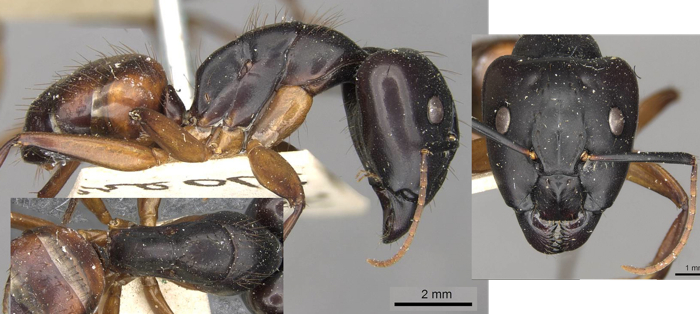 Major TL 13.5 mm;
head just longer than wide, petiole
with sharp dorsal border; mandibles striated, occiput very finely
spiculate giving dull appearance; dark
brown, head near black Major TL 13.5 mm;
head just longer than wide, petiole
with sharp dorsal border; mandibles striated, occiput very finely
spiculate giving dull appearance; dark
brown, head near black |
. |
| . | 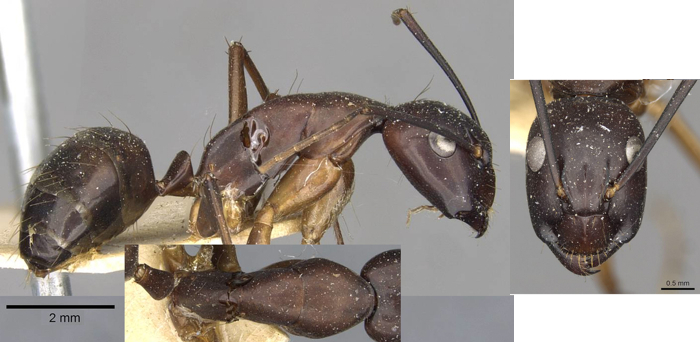 Media/minor Media/minor |
West Africa - chilon |
| -- | 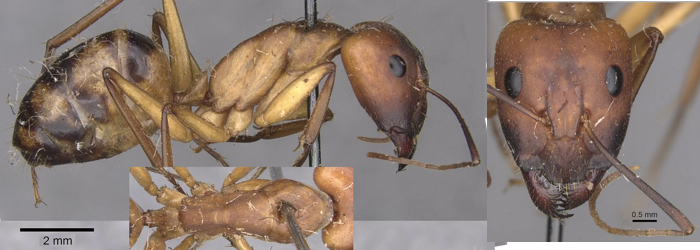 TL 14-16 mm; cf caffer
but more compressed with thinner scale and erect hairs on genae;
petiole scale thin; minor head only moderately narrowed behind; colour
like caffer or pale cognatus but with diffuse brownish
yellow lateral spots on basal three segments of gaster, head dull
sometimes more rusty-red TL 14-16 mm; cf caffer
but more compressed with thinner scale and erect hairs on genae;
petiole scale thin; minor head only moderately narrowed behind; colour
like caffer or pale cognatus but with diffuse brownish
yellow lateral spots on basal three segments of gaster, head dull
sometimes more rusty-red |
. |
| . | 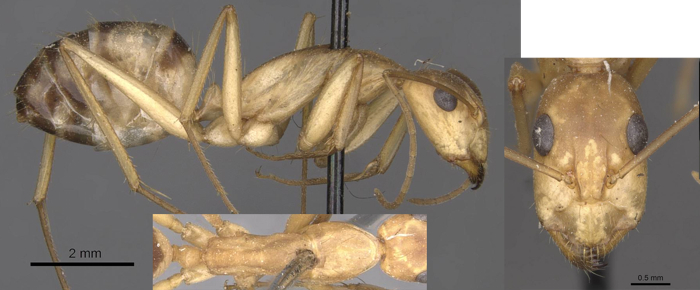 Minor Minor |
Southern Africa - importunus |
| -- | 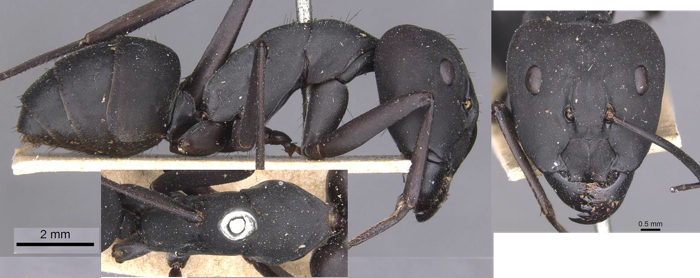 TL 12-15 mm;
Major head large and occiput strongly
scalloped; clypeus with a strong carina and large rectangular anterior
lobe; mandibles very finely striated; entirely black, appendages
variably reddish. TL 12-15 mm;
Major head large and occiput strongly
scalloped; clypeus with a strong carina and large rectangular anterior
lobe; mandibles very finely striated; entirely black, appendages
variably reddish.Minor - head narrower, oval and occiput hardly scalloped |
. |
| . | 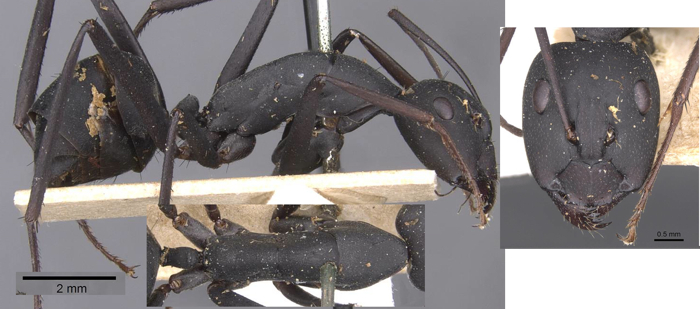 |
Somalia to Congo Basin - somalinus |
| - |
Petiole scale squamiform, thickness variable but without highly convex anterior face - smaller TL soldier < 10 mm; minor heads sub-ovoid to square; mostly dark near black - acvapimensis-group | - |
| 26 | Petiole scale thick with rounded apex in profile | 27 |
| -- | Petiole scale squamiform tapering to sharp apex | 28 |
| 27 | 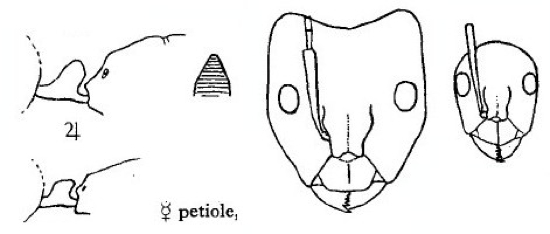 Major
TL 7.4 mm; (cf werthi) scapes not reaching occiput, occipital
margin convex; pronotum nearly three times as wide as long; propodeal
dorsum very narrow; petiole scale thick but 2.5 x higher than thick;
whitish pubescence very short, sparse and decumbent, erect hairs long
and whitish but very few; black, appendages mainly ferruginous Major
TL 7.4 mm; (cf werthi) scapes not reaching occiput, occipital
margin convex; pronotum nearly three times as wide as long; propodeal
dorsum very narrow; petiole scale thick but 2.5 x higher than thick;
whitish pubescence very short, sparse and decumbent, erect hairs long
and whitish but very few; black, appendages mainly ferruginous |
South Africa - errabundus |
| -- | 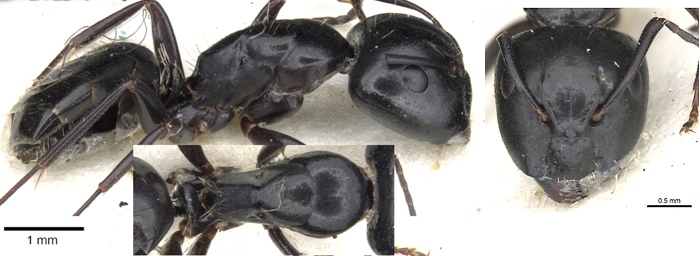 TL
6.5-8.2 mm; scapes surpass occiput by length of first funiculus
segment; hind margin of head straight; pronotum twice as wide as long;
propodeum dorsum one-third longer than wide; pubescence very short and
inconspicuous, erect hairs sparse long fairly pointed and not thick;
shining black, tarsi dark brown TL
6.5-8.2 mm; scapes surpass occiput by length of first funiculus
segment; hind margin of head straight; pronotum twice as wide as long;
propodeum dorsum one-third longer than wide; pubescence very short and
inconspicuous, erect hairs sparse long fairly pointed and not thick;
shining black, tarsi dark brown |
. |
| . | 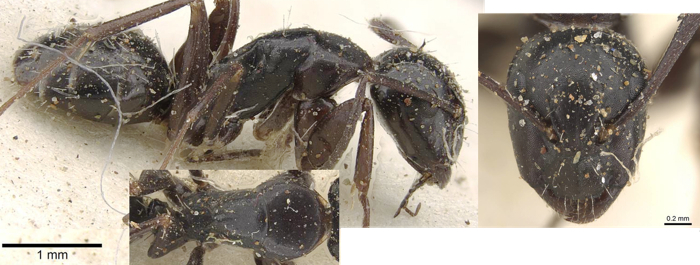 |
South Africa - werthi |
| 28 | TL > 10 mm | 29 |
| -- | TL maximum 10 mm | 30 |
| 29 | 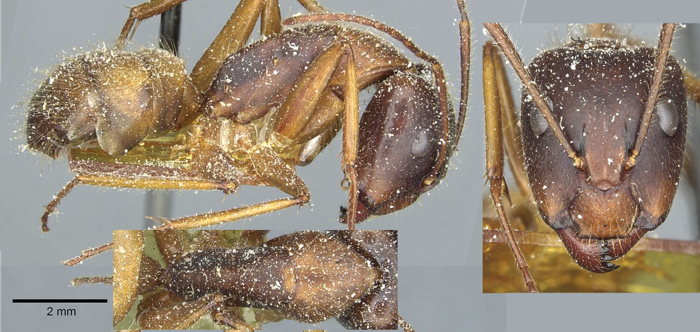 TL 11 mm; sculpturation of
dense reticulo-puncturation; with long grey-white erect pilosity; long
pubescence on the gaster; base colour dull brown-red, legs and gaster
reddish-yellow TL 11 mm; sculpturation of
dense reticulo-puncturation; with long grey-white erect pilosity; long
pubescence on the gaster; base colour dull brown-red, legs and gaster
reddish-yellow |
. |
| . | 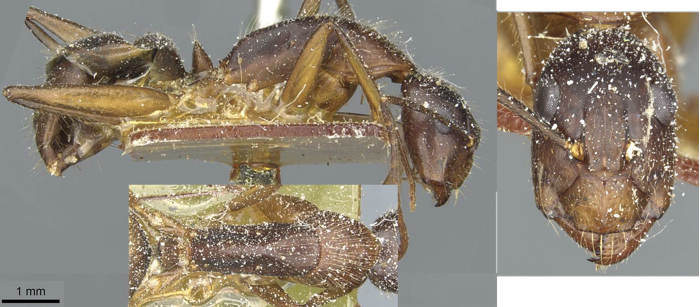 Minor Minor |
Cameroun - immigrans |
| -- | 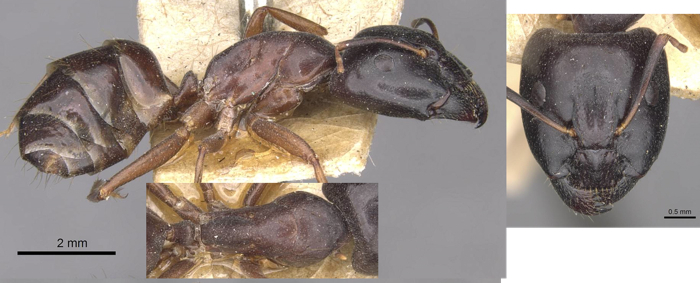 TL
9-11 mm, HL about the same as HW; head
trapezoidal not much narrower anteriorly, middle half of sides
straight, occiput moderately impressed; scapes just surpassing occiput;
alitrunk short and robust, propodeum dorsum very narrow; shiny, erect
hairs yellowish, none on sides of head; head black, most of rest
reddish brown, anterior of gaster paler TL
9-11 mm, HL about the same as HW; head
trapezoidal not much narrower anteriorly, middle half of sides
straight, occiput moderately impressed; scapes just surpassing occiput;
alitrunk short and robust, propodeum dorsum very narrow; shiny, erect
hairs yellowish, none on sides of head; head black, most of rest
reddish brown, anterior of gaster paler |
. |
| . | 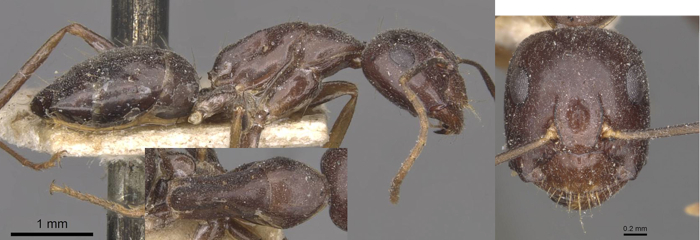 minor minor |
South Africa - thales |
| 30 | 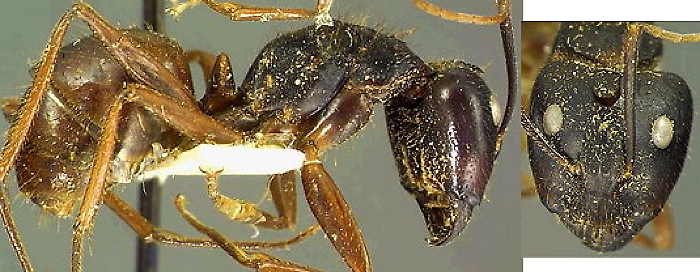 TL 9-10 mm; very dark
dull appearance with dense coarse,
fulvous red pilosity TL 9-10 mm; very dark
dull appearance with dense coarse,
fulvous red pilosity |
. |
| . | 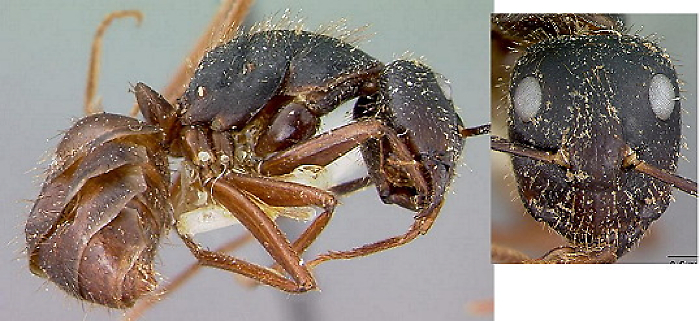 |
Congo Basin - maguassa |
| -- | TL < 10 mm | 31 |
| 31 | TL 9-10 mm | 32 |
| -- | TL < 9 mm | 33 |
| 32 | 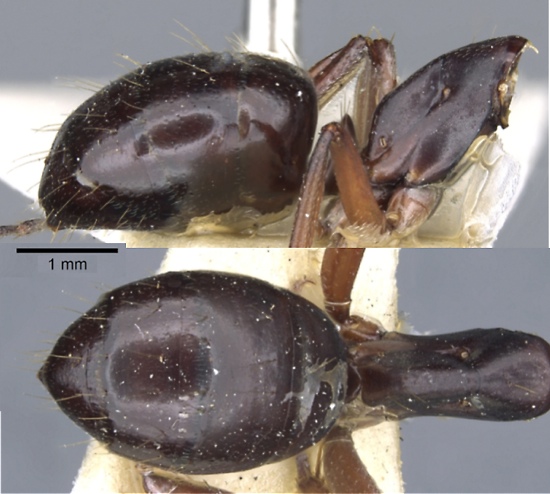 TL 9.0 mm; scapes surpass
occiput by about four times own breadth; propodeum longer than meso-
and metanotum together, dorsum longer than abrupt declivity; erect
hairs scanty, yellow; black, shiny, appendages dark brown to red (cf natalensis
but smaller and more compact, shinier) TL 9.0 mm; scapes surpass
occiput by about four times own breadth; propodeum longer than meso-
and metanotum together, dorsum longer than abrupt declivity; erect
hairs scanty, yellow; black, shiny, appendages dark brown to red (cf natalensis
but smaller and more compact, shinier) |
. |
| . | 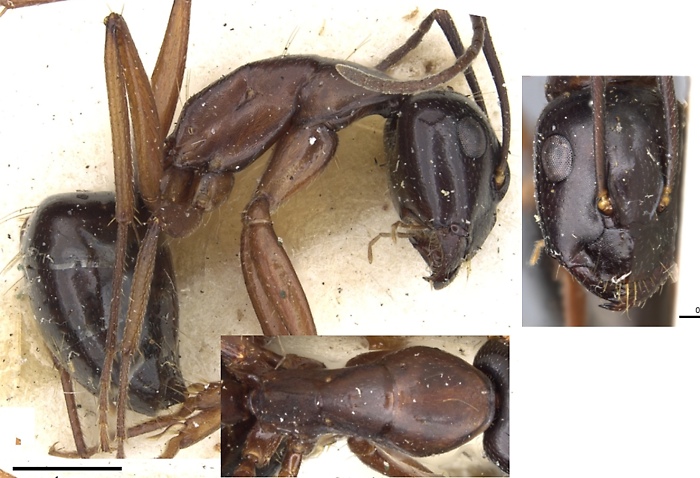 |
Ethiopia - ligeus |
| -- | 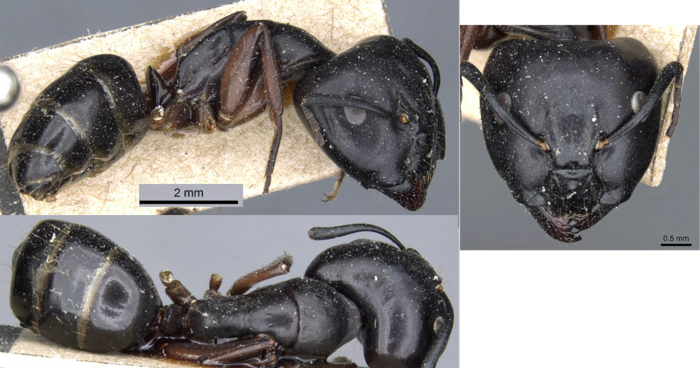 TL 9.5 mm, HW 3.5 HL 3.3 SL 2.4; cf natalensis ssp
corvus, clypeus obtusely carinate, with truncate
anterior lobe; occiput more deeply impressed, scape reaches to
two-thirds of distance from eye to occiput; piceous with appendages
ferruginous TL 9.5 mm, HW 3.5 HL 3.3 SL 2.4; cf natalensis ssp
corvus, clypeus obtusely carinate, with truncate
anterior lobe; occiput more deeply impressed, scape reaches to
two-thirds of distance from eye to occiput; piceous with appendages
ferruginous |
Somalia - sacchii |
| 33 | 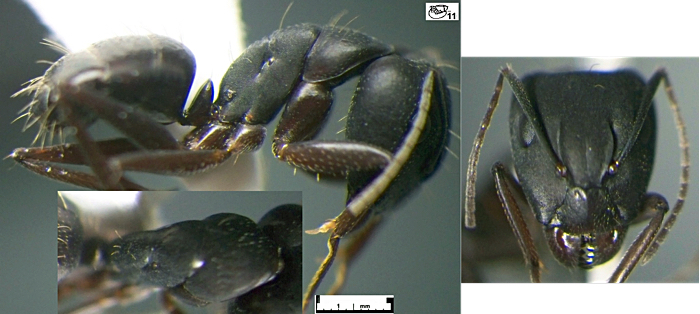 TL
ca 8.5 mm; clypeus without or only a short, posterior, median carina;
quite short and thickset; fine yellowish pilosity; all over dull pitch TL
ca 8.5 mm; clypeus without or only a short, posterior, median carina;
quite short and thickset; fine yellowish pilosity; all over dull pitch |
. |
| . | 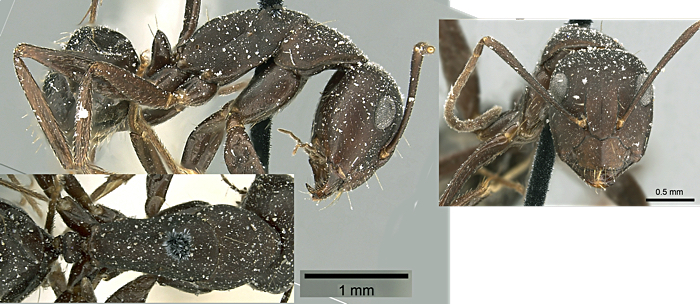 |
Sub-Saharan forest in sunlit ground - acvapimensis |
| -- | TL max 8.0 mm | 34 |
| 34 | TL ca 8.0 mm | 35 |
| -- | TL < 8.0 mm | 36 |
| 35 | 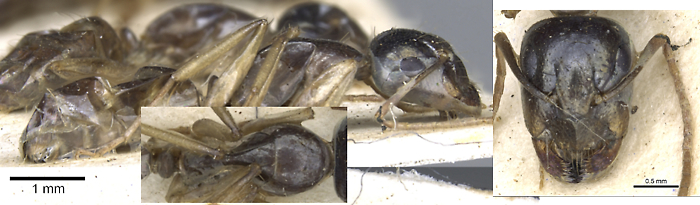 TL
8.0 mm; scapes surpass occiput; propodeum angular and high, narrow in
dorsal view; brownish-black, apex of gaster testaceous, anterior of
head and appendages rust to brown-red (related to cleobulus) TL
8.0 mm; scapes surpass occiput; propodeum angular and high, narrow in
dorsal view; brownish-black, apex of gaster testaceous, anterior of
head and appendages rust to brown-red (related to cleobulus)minor worker |
Lesotho - basuto |
| -- | 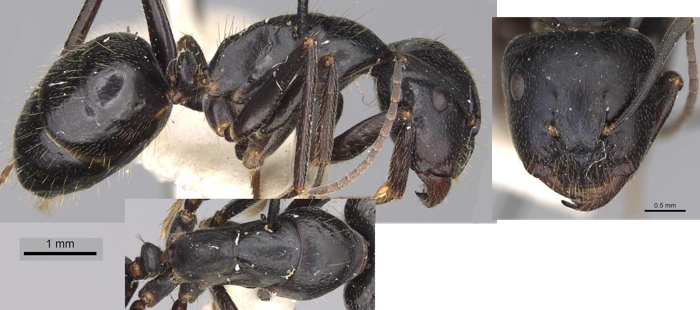 TL 8.0 mm, HL 2.2 HW 2.1; eyes small; sculpture
as thales but more puncturations between frontal carinae and
larger on mandibles; black, gaster with posterior margins yellowish;
mandibles reddish, appendages brown TL 8.0 mm, HL 2.2 HW 2.1; eyes small; sculpture
as thales but more puncturations between frontal carinae and
larger on mandibles; black, gaster with posterior margins yellowish;
mandibles reddish, appendages brown |
South Africa - cleobulus |
| 36 | 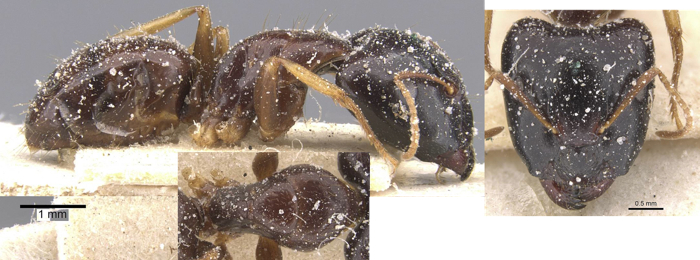 TL
4-7 mm, scapes short; brown-black, fairly shiny; profile of propodeum a
smooth curve TL
4-7 mm, scapes short; brown-black, fairly shiny; profile of propodeum a
smooth curve |
. |
| . | 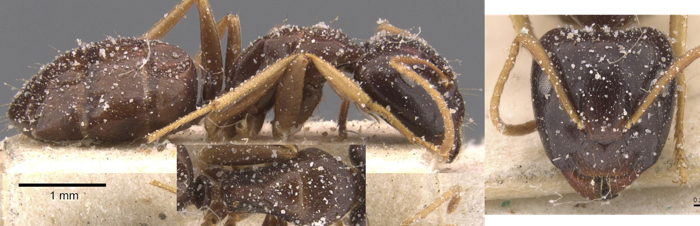 |
Congo Basin (?Guinea) - agonius |
| -- | Profile of propodeum distinctly angular | 37 |
| 37 | 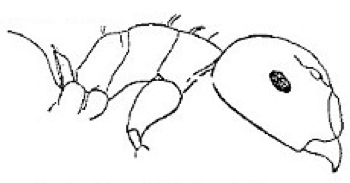 TL
6-6.5 mm; less shiny; scapes short; dorsum of propodeum one-third
shorter than
declivity, slightly lowered and curve into declivity obtuse;
brown-black but head darker TL
6-6.5 mm; less shiny; scapes short; dorsum of propodeum one-third
shorter than
declivity, slightly lowered and curve into declivity obtuse;
brown-black but head darker |
. |
| . | 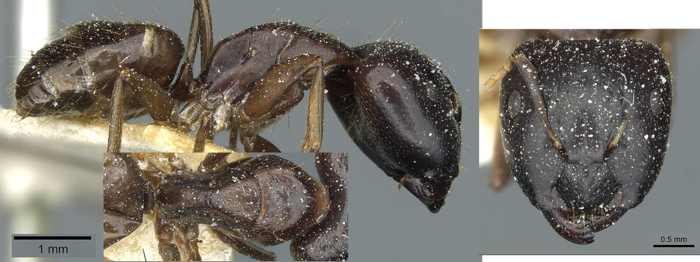 |
|
| . | 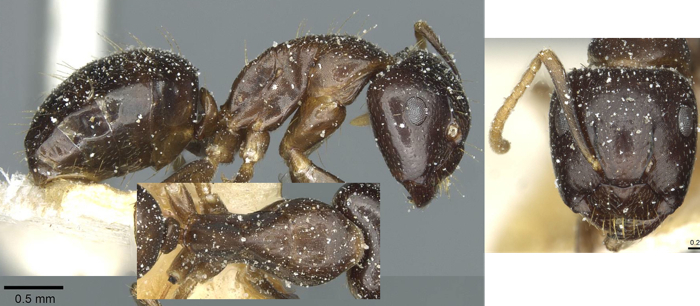 |
Congo Basin - roubaudi |
| -- | 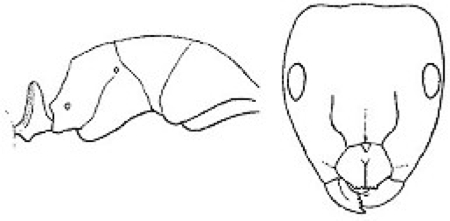 TL
7.5 mm; (cf cleobolus) scapes reach occiput; shiny, with just
visible microscopic reticulation, plus few large hair-pits; a few
yellowish hairs on head, six on pronotum, four on middle of propodeum,
two on each side of petiole; brownish-black, appendages reddish-brown,
coxae and base of femur yellowish white TL
7.5 mm; (cf cleobolus) scapes reach occiput; shiny, with just
visible microscopic reticulation, plus few large hair-pits; a few
yellowish hairs on head, six on pronotum, four on middle of propodeum,
two on each side of petiole; brownish-black, appendages reddish-brown,
coxae and base of femur yellowish white |
. |
| . | 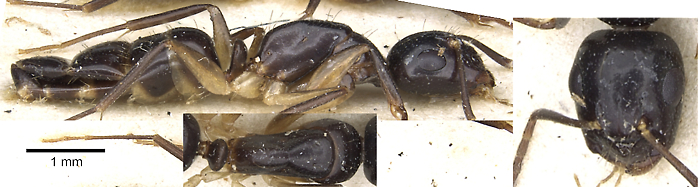 Minor worker Minor worker |
South Africa - dicksoni |
| -- | 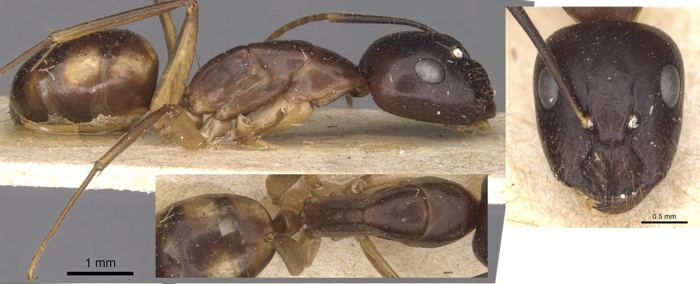 TL 6-8.5 mm; minor
with near square head; quite dark brown TL 6-8.5 mm; minor
with near square head; quite dark brown |
. |
| . | 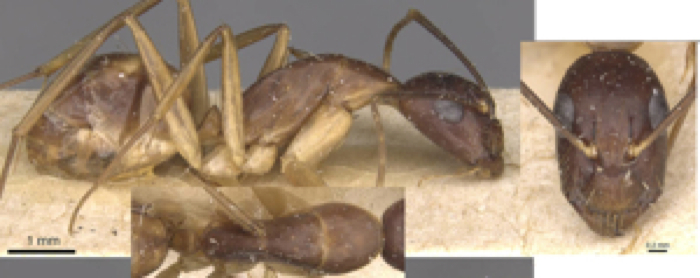 |
Tanzania - minusculus - new status |
 |
Genus page |
© 2007, 2008, 2009, 2010, 2013, 2014, 2017, 2018 - Brian
Taylor
CBiol
FRSB FRES 11, Grazingfield, Wilford, Nottingham, NG11 7FN, U.K. |
href="tanaemyrmex.htm"