
SUBFAMILY MYRMICINAE - Genus Cardiocondyla
|
|
The Ants of
Africa SUBFAMILY MYRMICINAE - Genus Cardiocondyla |
| Contents - Myrmicinae - MYRMICINAE Introduction |
In Tribe FORMICOXENINI.
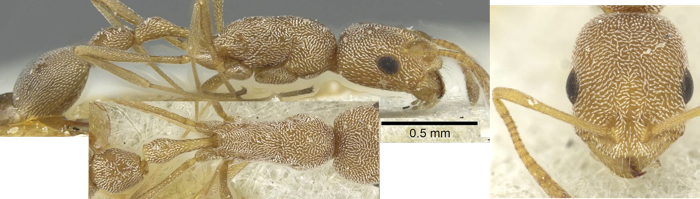
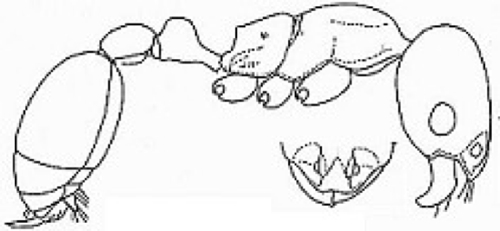
Diagnostic Features - Eyes well developed and sited forward of the front of the midlength of the head. Antennae 12-segmented, with a three-segmented club, and the scapes short, failing to reach the posterior margin of the head. The lateral portions of the clypeus project forwards over the basal margins of the mandibles. Sculpture usually of fine dense puncturation on the head and alitrunk, but none on the gaster. Sparse pubescence but erect setae only on the anterior clypeal margin. Alitrunk with the promesonotal suture absent and the metanotal groove impressed. Propodeum with a pair of teeth or spines. Petiole with a long peduncle in front; in dorsal view the post-petiole is very broad. Middle and hind tibiae without spurs.
Emery's (1869b) genus description is at 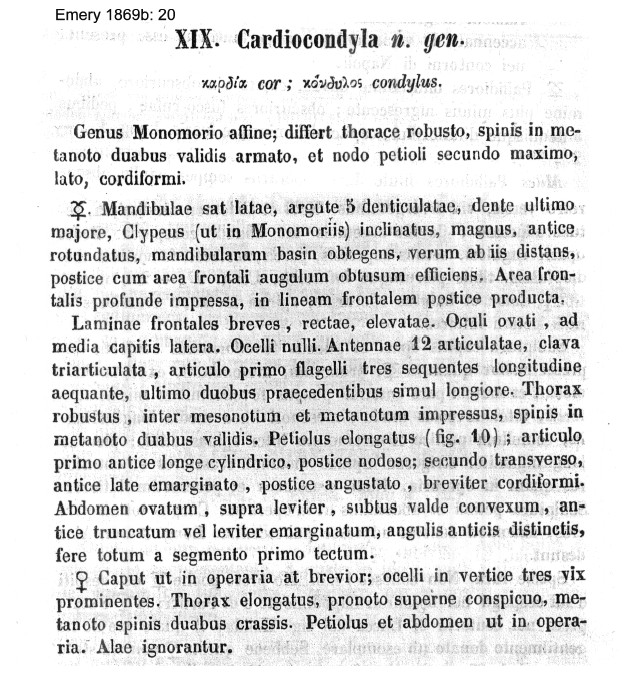 . Arnold (1916) gave a genus description,
this is at
. Arnold (1916) gave a genus description,
this is at 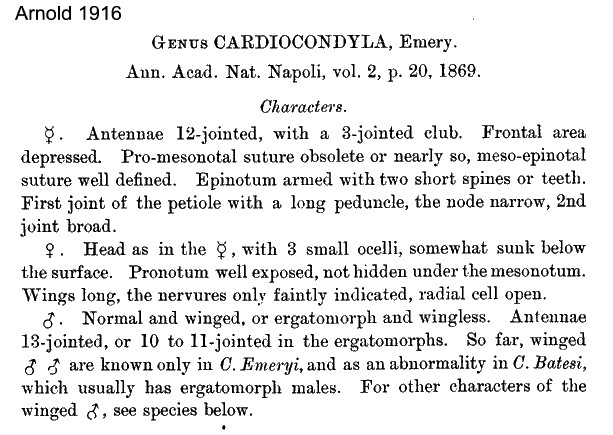 .
.
Revised by Bolton (1982). All small to minute ants which nest in
soil, usually at the bases of trees, or in compressed leaf litter.
Belshaw & Bolton (1994) noted that three species are known from
Ghana. The full text of Bolton's revision can be seen at -
Bolton,
B. 1982. Afrotropical species of the myrmicine ant genera Cardiocondyla,
Leptothorax, Melissotarsus, Messor and Cataulacus
(Formicidae). Bull.
Brit. Mus. (Nat. Hist.) Entomol. 45:
307-370. View or download entire file (7.6M)  .
.
Rigato (2002) described three new species from sub-Saharan Africa. Two, longinoda and luciae were from Tanzania and one, yorubae, came from Nigeria. The latter however, seems to differ little from emery. Moreover, it exactly matches the specimen I drew from Nigeria and collected at some time by Barry Bolton. Rigato, who was supplied with the specimens he described by Bolton, makes no mention of sighting either emery from any other source. I, therefore, tentatively regard yorubae as a junior synonym of emeryi.
In contrast to Rigato, Seifert (2003) made an extremely detailed and sophisticated study of primarily Holarctic Cardiocondyla. Although published later, this study surely, at least, overlaps that by Rigato. Seifert included all but two of the species in Bolton (1982) and transferred globinodis and badonei from wroughtoni to venustula. The latter thus was added to the list from sub-Saharan Africa, as is C. mauritanica (a Zimbabwe record)
Key to species known from Africa (derived from Bolton, 1982, and revised to incorporate Rigato, 2002):
| ¤ | 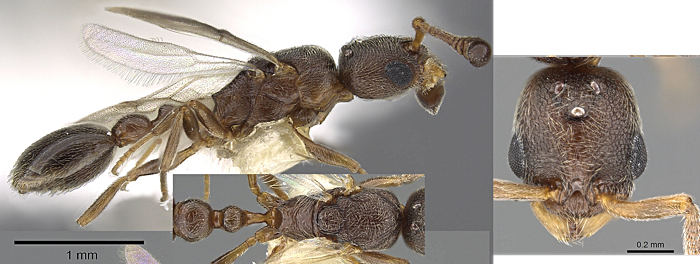 Queen only known; dark brown to blackish brown Queen only known; dark brown to blackish brown |
Nigeria - zoserka |
| 1 | 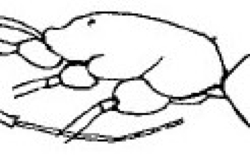 Alitrunk dorsum
without metanotal groove or impression; propodeum unarmed; TL 2.7 mm;
yellow with silvery pubescence Alitrunk dorsum
without metanotal groove or impression; propodeum unarmed; TL 2.7 mm;
yellow with silvery pubescence |
. |
| . |  |
Angola - monardi |
| -- |  Alitrunk dorsum with distinct metanotal groove;
propodeum sharply angulate or bispinose Alitrunk dorsum with distinct metanotal groove;
propodeum sharply angulate or bispinose |
2 |
| 2 | 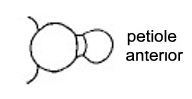 In full face view
scapes distinctly exceeding occipital margin; TL 2.5 mm; bright
ferruginous In full face view
scapes distinctly exceeding occipital margin; TL 2.5 mm; bright
ferruginous |
Sudan - as a junior synonym of fajumensis - nilotica |
| -- | Scapes not exceeding occipital margin | 3 |
| 3 | 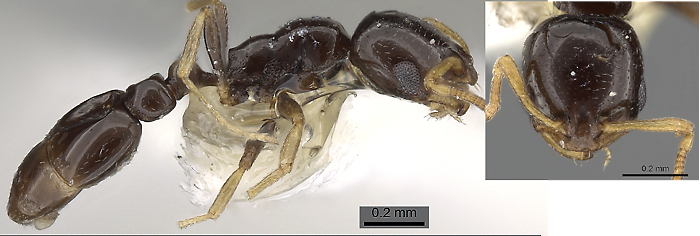 Dorsal surfaces of head and
alitrunk smooth and glossy, unsculptured except for minute puncturation
on head; TL 1.8 mm; uniform glossy blackish brown Dorsal surfaces of head and
alitrunk smooth and glossy, unsculptured except for minute puncturation
on head; TL 1.8 mm; uniform glossy blackish brown |
Ghana - sekhemka |
| -- | Dorsal surfaces of head, alitrunk or both finely and densely sculptured | 4 |
| 4 | Dorsum of gaster distinctly finely shagreened, not smoother than head or alitrunk | 5 |
| -- | Dorsum of gaster not shagreened, smoother than head or alitrunk | 6 |
| 5 | 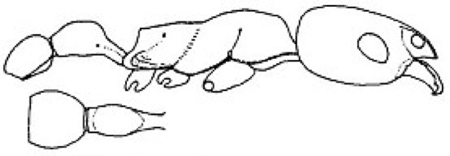 Petiole with elongate
node, 1.5 X longer than wide, with a low profile; TL 2.1 mm; scape
relatively long SI 97-100; testaceous yellow Petiole with elongate
node, 1.5 X longer than wide, with a low profile; TL 2.1 mm; scape
relatively long SI 97-100; testaceous yellow |
. |
| . | 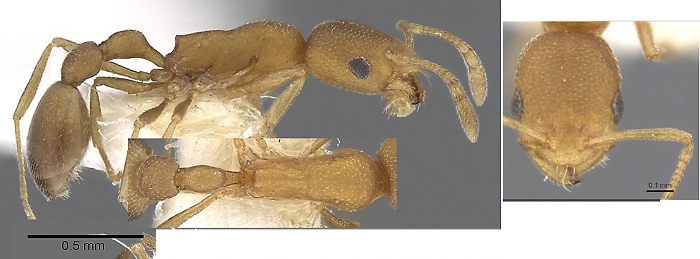 . . |
Tanzania - longinoda |
| -- | 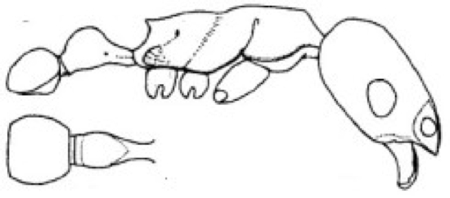 Petiole with shorter
node, less than 1.5 X longer than wide, with a domed profile; TL 2.1
mm; scape relatively long SI 90; reddish brown, gaster duller, antennal
club darker Petiole with shorter
node, less than 1.5 X longer than wide, with a domed profile; TL 2.1
mm; scape relatively long SI 90; reddish brown, gaster duller, antennal
club darker |
. |
| . | 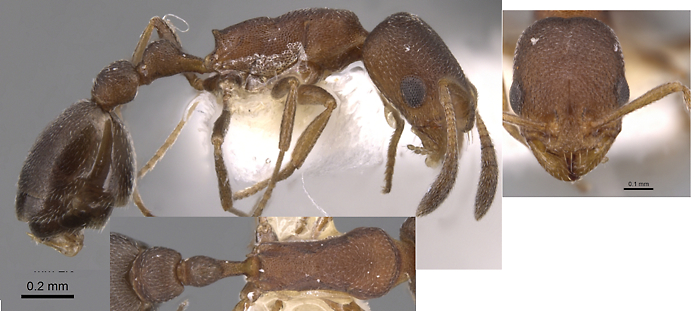 |
Tanzania - luciae |
| 6 | 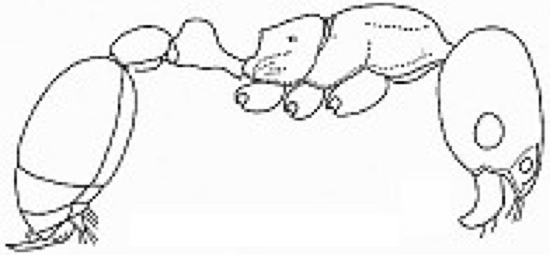 Propodeum in absolute
profile bluntly angulate to bidenticulate, never with a pair of strong
teeth or spines which are longer than their basal width in profile;
scapes relatively long; TL 2.0-2.6 mm; medium brown to blackish-brown Propodeum in absolute
profile bluntly angulate to bidenticulate, never with a pair of strong
teeth or spines which are longer than their basal width in profile;
scapes relatively long; TL 2.0-2.6 mm; medium brown to blackish-brown |
Pan-African - shuckardi |
| -- | Propodeum in profile strongly bidentate to bispinose; scapes relatively short | 7 |
| 7 | 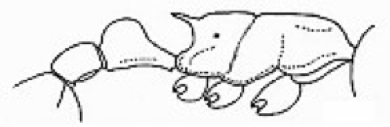 In profile alitrunk with
propodeal dorsum approximately flat behind the propodeal groove, more
or less level with the promesonotal dorsum, and not sloping gradually
down to the spines; TL 1.9 mm; alitrunk medium-brown, appendages
lighter, head dorsally and gaster blackish-brown to black In profile alitrunk with
propodeal dorsum approximately flat behind the propodeal groove, more
or less level with the promesonotal dorsum, and not sloping gradually
down to the spines; TL 1.9 mm; alitrunk medium-brown, appendages
lighter, head dorsally and gaster blackish-brown to black |
Cameroun - weserka |
| -- | Alitrunk dorsum convex behind metanotal groove, then sloping down to spines | 8 |
| 8 | 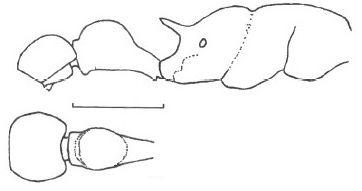 In profile alitrunk
with sharp drop into metanotal groove; TL 1.6-1.9 mm; head, alitrunk
and appendages yellow to yellowish brown but gaster variable from same
colour to much darker In profile alitrunk
with sharp drop into metanotal groove; TL 1.6-1.9 mm; head, alitrunk
and appendages yellow to yellowish brown but gaster variable from same
colour to much darker |
Pantropical tramp - wroughtonii |
| In profile alitrunk with even curve into metanotal groove | 9 | |
| 9 | 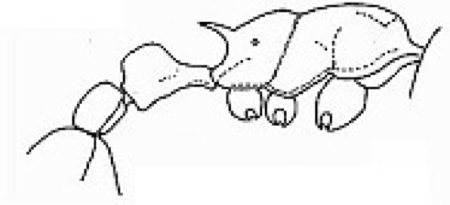 Pronotal corners bluntly
but conspicuously angular in dorsal view; propodeal spines relatively
long and slender; TL 1.80-1.81 mm; light brownish yellow; sides of
first gastral tergite a rich darker brown Pronotal corners bluntly
but conspicuously angular in dorsal view; propodeal spines relatively
long and slender; TL 1.80-1.81 mm; light brownish yellow; sides of
first gastral tergite a rich darker brown |
West Africa - neferka |
| -- | 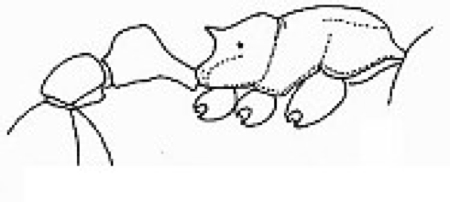 Pronotal corners rounded in
dorsal view, propodeal spines relatively short and stout; TL 1.8 mm;
colour orange with gaster and antennal club brown Pronotal corners rounded in
dorsal view, propodeal spines relatively short and stout; TL 1.8 mm;
colour orange with gaster and antennal club brown |
Pantropical tramp - emeryi (yorubae) |
|
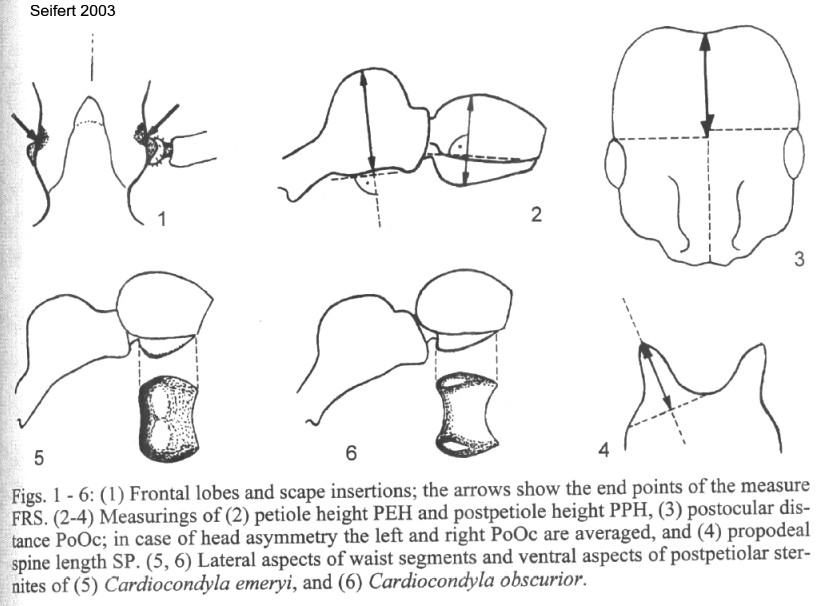
Key following Seifert (2003); with addition of wasmanni, 2009
CL - HL on median line; CS = median of CW+CL; FRS = distance of frontal carinae immediately caudal of the posterior intersection points betwwen the frontal cariane and the dorsal lamellae of the torus; PPH = maximum postpetiole height; mesosoma used rather than alitrunk. The scale on his illustrations of the main worker is 213 µm. I find that for a field worker or, indeed, anyone without very high quality equipment, his key as it stands is not easy too use. |
||
| 1 | 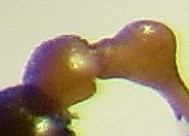 Postpetiole with prominent anteroventral corners; seen
from a frontal angle the anterior margin is concave Postpetiole with prominent anteroventral corners; seen
from a frontal angle the anterior margin is concave |
2 |
| -- | 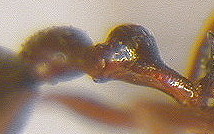 Postpetiole without prominent anteroventral corners Postpetiole without prominent anteroventral corners |
5 |
| 2 | Head short CL/HW < 1.19 | 3 |
| -- | Head longer, frons narrower | 4 |
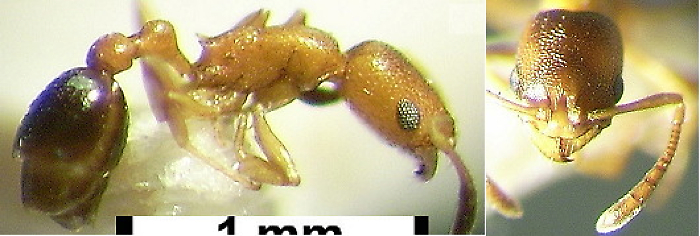
| 3 | 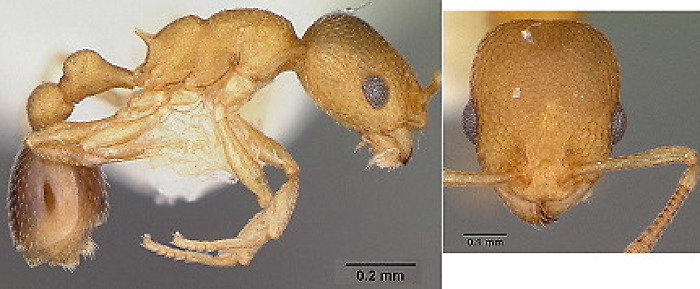 First and following
gaster tergites not equally dark [In profile alitrunk with sharp drop
into metanotal groove; TL 1.6-1.9 mm; head, alitrunk and appendages
yellow to yellowish brown but gaster variable from same colour to much
darker] First and following
gaster tergites not equally dark [In profile alitrunk with sharp drop
into metanotal groove; TL 1.6-1.9 mm; head, alitrunk and appendages
yellow to yellowish brown but gaster variable from same colour to much
darker] |
cosmopolitan tramp; Tanzania & Somalia - wroughtonii |
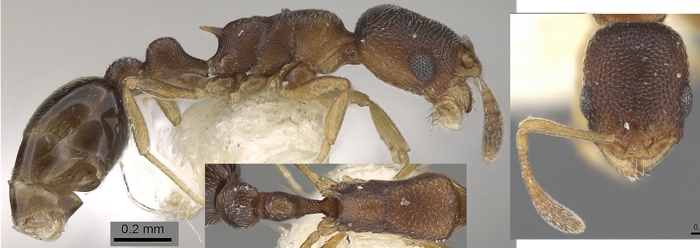
| -- |  First and following
gaster tergites equally dark First and following
gaster tergites equally dark |
cosmopolitan tramp but the single Kenya record (worker, Kaijado, x.1999) may be an error - obscurior |
| 4 | 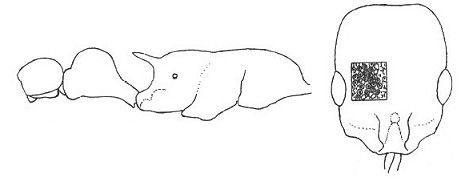 Alitrunk (mesosoma) profile relatively flat, metanotal
groove shallow, pronotum with more rounded shoulders [In profile
alitrunk with propodeal dorsum approximately flat behind the propodeal
groove, more or less level with the promesonotal dorsum, and not
sloping gradually down to the spines; TL 1.9 mm; alitrunk medium-brown,
appendages lighter, head dorsally and gaster blackish-brown to black] Alitrunk (mesosoma) profile relatively flat, metanotal
groove shallow, pronotum with more rounded shoulders [In profile
alitrunk with propodeal dorsum approximately flat behind the propodeal
groove, more or less level with the promesonotal dorsum, and not
sloping gradually down to the spines; TL 1.9 mm; alitrunk medium-brown,
appendages lighter, head dorsally and gaster blackish-brown to black] |
. |
| . |  . . |
Cameroun - weserka |
| -- | 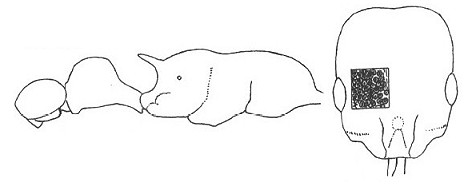 Alitrunk (mesosoma) and propodeum profile slightly convex,
metanotal groove distinct, pronotum with well-developed shoulders, each
with a rounded angle of 120° [Pronotal corners bluntly but
conspicuously angular in dorsal view; propodeal spines relatively long
and slender; TL 1.80-1.81 mm; light brownish yellow; sides of first
gastral tergite a rich darker brown] Alitrunk (mesosoma) and propodeum profile slightly convex,
metanotal groove distinct, pronotum with well-developed shoulders, each
with a rounded angle of 120° [Pronotal corners bluntly but
conspicuously angular in dorsal view; propodeal spines relatively long
and slender; TL 1.80-1.81 mm; light brownish yellow; sides of first
gastral tergite a rich darker brown] |
. |
| . | 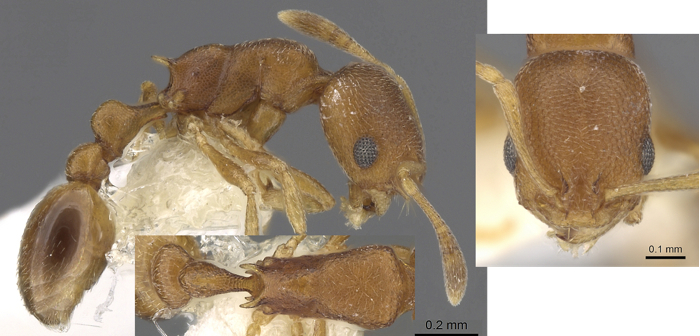 |
West Africa - neferka |
| 5 | 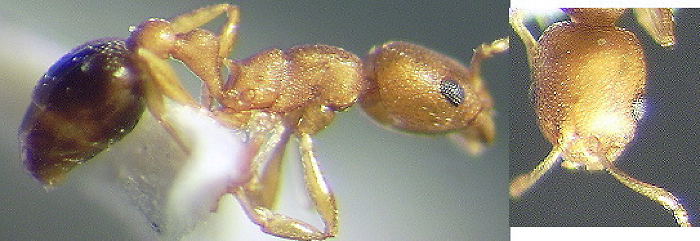 FRS/PPH < 0.722;
small CS 386-457 µm; head elongated CL/CW 1.19-1.27; postpetiole as
high as petiole with conspicuous ventral bulge; propodeal spines
moderately long FRS/PPH < 0.722;
small CS 386-457 µm; head elongated CL/CW 1.19-1.27; postpetiole as
high as petiole with conspicuous ventral bulge; propodeal spines
moderately long |
widespread tramp - emeryi |
| . | 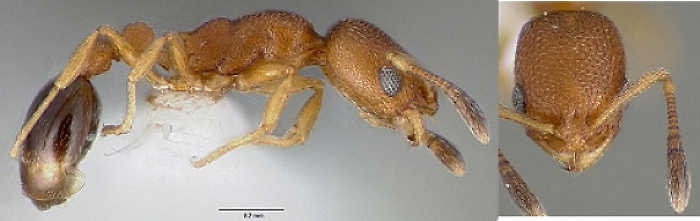 dark form
apparently common in Congo Basin dark form
apparently common in Congo Basin |
emeryi |
| -- | FRS/PPH > 0.722 | 6 |
| 6 | Propodeal spines in lateral view with blunt angles of 95-120°; sides of postpetiole in dorsal view always rounded convex; promesonotal and anterior propodeal profiles forming shallowly convex curvatures to give a wide metanotal depression | shuckardi-group - 7 |
| -- | 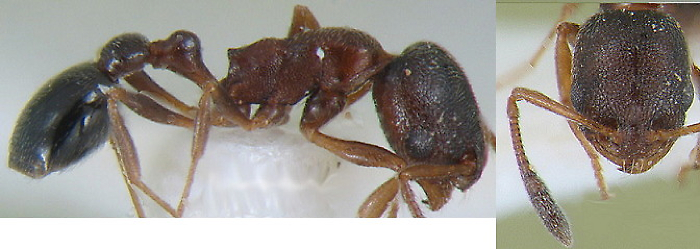 Propodeal spines in
lateral view with smaller angles of 60-95°; sides of postpetiole in
dorsal view more angular; promesonotal and anterior propodeal profiles
not forming shallowly convex curvatures, so metanotal depression weak
or absent Propodeal spines in
lateral view with smaller angles of 60-95°; sides of postpetiole in
dorsal view more angular; promesonotal and anterior propodeal profiles
not forming shallowly convex curvatures, so metanotal depression weak
or absent |
Zimbabwe (once; gyne only, vii.1995) - nuda-group - mauritanica |
| 7 | 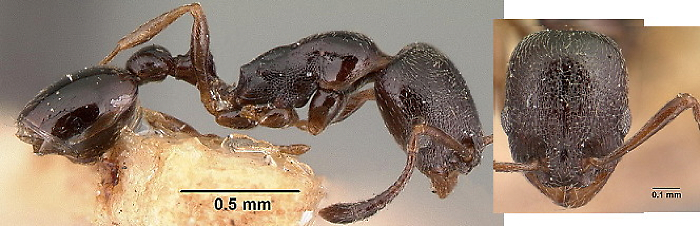 Scape relatively
short SL/CS 0.79-0.84; postpetiole wider; metanotal depression
shallower; unicolorous medium to dark brown Scape relatively
short SL/CS 0.79-0.84; postpetiole wider; metanotal depression
shallower; unicolorous medium to dark brown |
southern East Africa - shuckardi |
| 7a | 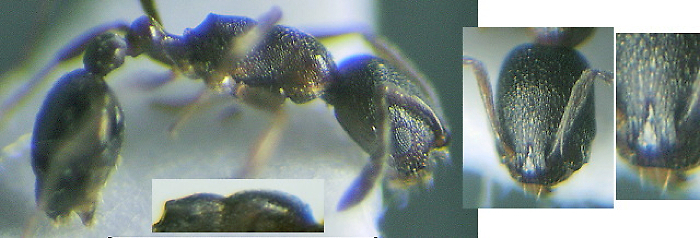 Generally more heavily
built and with much more distinct sculpturation on the head and
alitrunk; also metanotal impression quite deeply impressed both
dorsally and laterally Generally more heavily
built and with much more distinct sculpturation on the head and
alitrunk; also metanotal impression quite deeply impressed both
dorsally and laterally |
West Africa and Congo Basin East Africa - wassmanni |
| -- | Scape longer SL/CS 0.81-0.87; postpetiole narrower; metanotal depression deeper | 8 |
| 8 | 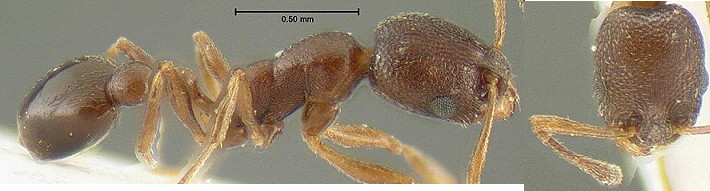 Eye larger; all over dark brown, smaller CS 467-572 µm Eye larger; all over dark brown, smaller CS 467-572 µm |
south-eastern Africa - venustula |
| -- | 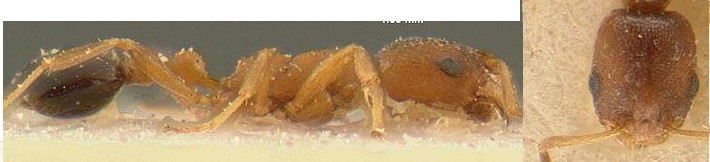 Eye smaller; head and alitrunk variably yellowish, gaster
dark to blackish-brown, larger CS 556-633 µm Eye smaller; head and alitrunk variably yellowish, gaster
dark to blackish-brown, larger CS 556-633 µm |
Sudan (as nilotica) - fajumensis |
 |
MYRMICINAE Introduction |
© 2007, 2009, 2013, 2014, 2019 - Brian Taylor CBiol FRSB FRES 11, Grazingfield, Wilford, Nottingham, NG11 7FN, U.K. |
href="cardiocondyla.htm"
 Note - this does not include monardi